
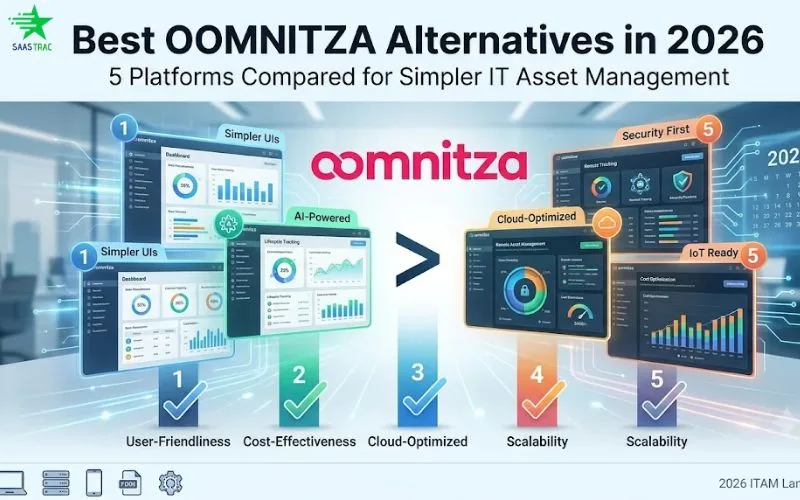
Research teams looking for alternatives to Oomnitza are not usually satisfied with enterprise IT asset management. More frequently, they’re asking, “How much does that cost to get there? — a modular quote, a multi-week implementation, and an admin who spends more time configuring workflows than acting on the data. For mid-market organizations, it typically offers the same visibility into hardware, software licenses, users, and spend, but with ITAM software that is faster to deploy and easier to budget for.
The straight answer is that the correct Oomnitza alternative depends on what part of Oomnitza you’re using. An all-in-one ITAM platform is the best alternative if you need hardware and software asset management, consistent pricing, and quick setup. For those who are focused on enterprise software license compliance or security, visibility, or SaaS spend, is far more specific and may fit better in a more specialized tool, either in addition to, or instead of, a more general ITAM system.
This guide details Oomnitza’s pricing structure, five options for each of five categories, and a weighted scorecard and timeline to support the smoothest possible transition to Oomnitza in 2026.
What Oomnitza Does Well, and Why Teams Still Look Elsewhere
Oomnitza is a business technology management platform. It monitors endpoints, servers, peripherals, accessories, cloud computing, and IoT and OT devices, as well as installed, SaaS, and cloud software entitlements. Setyl’s research revealed that Oomnitza’s real strength is its large integration catalog (over 170 native integrations), a highly customizable workflow builder, write-back to connected systems, AI agent support via Oomnitza’s MCP, and no licensing per admin/technician seat.
Those strengths are targeted at large businesses. Oomnitza’s own pricing page states that it’s designed for companies with multiple systems containing asset information and recommends that companies with a handful of hundred assets from a single source would be better off using a lighter solution. For mid-sized companies, three issues come up most often:
- Implementation effort. Setup typically takes several weeks to months and requires dedicated internal resources.
- Admin overhead. Highly configurable workflows need someone with the time and skills to build and maintain them.
- Pricing complexity. Oomnitza’s quotes combine several components, which makes the total harder to predict.
The Five Types of Oomnitza Alternatives
Oomnitza covers a lot of ground, so its alternatives fall into distinct categories. Knowing which category you need prevents paying for a second enterprise platform you’ll only half use.
- All-in-one ITAM platforms cover hardware, software licenses, people, and spend in a single system. This is the closest like-for-like replacement for mid-market teams.
- Enterprise software asset management suites focus on license compliance, audit defense, and technology intelligence at very large scale.
- Cyber asset management platforms aggregate asset data from security and IT tools to find coverage gaps and exposures.
- ITSM suites with built-in asset management combine a service desk with an asset inventory, which suits teams that want to replace both at once.
- SaaS management platforms cover software subscriptions, usage, and renewals, but not physical hardware.
The 5 Best Oomnitza Alternatives in 2026
1. Setyl: Best All-in-One Oomnitza Alternative for Mid-Sized IT Teams
Setyl is IT asset and license management software that gives IT teams visibility into who owns what, what it costs, where it is, and when it expires. Setyl includes all things hardware, software, and SaaS licenses, people, vendors, IT spend, and compliance all in one platform, and is targeted to in-house IT teams in organizations with approximately 80 to 5,000 employees. Teams generally move from Oomnitza to Setyl for a less complex system, faster time to value, and lower cost.
Oomnitza Modules vs. Setyl Plans
The biggest difference is packaging. Where Oomnitza separates capabilities into modules and tiers, Setyl includes its core features in every plan.
| What You’d Buy Separately in Oomnitza | How Setyl Handles It |
| Assets and Peripherals modules | Hardware asset management, including peripherals and non-IT assets, with unlimited assets on every plan |
| Software module (Enterprise package required) | Software, SaaS and license management, with SaaS discovery through SSO and identity providers, unused license detection and renewal tracking |
| Integrations (10 on Essentials) | 100+ native integrations, including Jamf, Microsoft Intune, NinjaOne, Mosyle, CrowdStrike, Okta, BambooHR, HiBob, Workday, NetSuite and Xero |
| Onboarding and offboarding automation | HR-triggered joiner and leaver workflows that list every asset, license and admin role to assign or recover |
| Risk detection | Risk detection, an information asset register and a security audit checklist for ISO 27001 and SOC 2 |
| MCP and API access (Enterprise package) | API access and an MCP connector for Claude, ChatGPT and other AI assistants |
| Customer success tiers | Unlimited one-on-one support by email, chat and video on every plan, plus an optional managed service |
Switching From Oomnitza. Oomnitza is used by teams to export their data; Setyl’s team imports it and cleans up stale or duplicate records. The MDM, identity, and HR tools then automatically update records. Setyl can be set up in as little as one hour, and teams can run a proof of concept with Oomnitza until the end of their contract.
Proof and Pricing. Ebury controls thousands of devices across a global estate with Setyl, and their clients include Verisure, Pagaya, Biesse and the University of Oxford. Setyl received ratings of 4.8 on G2 and 4.9 on Capterra, while Oomnitza received ratings of 4.6 on both G2 and Capterra. Setyl was deemed to be the easiest to set up and most responsive to user support by G2, earning the 2026 Easiest Setup and Best Support awards. Plans (Complete, Advanced, and Advanced Managed) are based on the number of employees, start at $300/month, and include a free trial. Setyl is certified to ISO 27001 and GDPR.
2. Flexera One: Best for Enterprise Software License Compliance
Why Flexera One Is on the List. Flexera One is the SaaS suite for managing technology spend and risk across hardware, software, SaaS, and cloud. Flexera’s business is software licensing. The ITAM and SAM features support vendor audit defense and renewal negotiations, and Flexera claims it’s IBM-certified and Oracle-verified. Normalized messy software inventory data powers Flexera One with Technopedia, a catalog of over 5 million technology products from over 100,000 technology vendors. The suite also offers SaaS management and cloud cost optimization for AWS, Azure, and Google Cloud.
Before You Sign. List prices are not available for Flexera. According to Vendr, the average Flexera contract is about $7,900 per year, with observed contract values ranging from about $5,200 to $81,300, and professional services can cost 20% to 50% of the first-year software value. Flexera One is designed for large, complex estates, particularly those with a heavy IBM, Oracle, or Microsoft footprint. It could be the difference between one big implementation and another for a mid-sized firm without a major audit risk.
3. Axonius: Best for Security-Led Asset Visibility
Who Axonius Is Really For. Axonius is a cyber asset attack surface management (CAASM) platform. Axonius is not a system of record and is updated by IT teams; instead, it works with the tools you already run and syncs their data into a common asset model with over 1,400 adapters. Axonius then identifies devices with no security controls, risky identities and SaaS apps, and systems that are off track from what they should be. In May 2026, Axonius reported $200m+ ARR and nearly 1,000 customers, including over 100 Fortune 1000 companies and over 90 US federal agencies.
Questions to Ask in an Axonius Demo
- Will the IT team use Axonius day-to-day, or mainly the security team?
- How does Axonius handle asset lifecycle tasks such as procurement, assignment, warranty, and disposal?
- Can Axonius run onboarding and offboarding, or does it hand that work to other systems?
- Which modules (Cyber Assets, Software Assets, SaaS Applications, Identities) are needed for the scope you’re replacing, and how is each priced?
Axonius is quote-based. It’s a strong fit when security visibility is the driver, but teams replacing Oomnitza’s lifecycle and workflow features often need it alongside a dedicated ITAM platform rather than instead of one.
4. SysAid: Best for Bundling a Service Desk with Asset Management
The Bundle Math. SysAid is an ITSM platform with asset management built in, so it’s ideal for teams that want to eliminate their service desk and Oomnitza altogether. SysAid’s Professional plan is $59/month/agent, and Enterprise is custom-priced, with a minimum of 20 agents per month. Both plans include 250 managed assets, network discovery, CMDB, inventory management, and License Manager Essentials for contract renewal tracking and reminders. Additional asset packs and Lansweeper Advanced Discovery and License Manager Advanced, which includes SaaS usage tracking and shadow IT detection, are paid add-ons.
Strengths and Limits. More than 500 people have written over 4.5 reviews for SysAid on Capterra, and the platform’s AI features are becoming more prominent, such as the Dex autonomous IT engineer. Pricing is agent-based, however, and the more agents that are serviced, the more expensive it will be; there are packs for assets over 250. Teams that already have a service desk they enjoy may discover they are paying for ITSM they don’t need. Also check that the current price of this plan is from $89 per agent/month, which is what is listed on SysAid’s pricing page.
5. Torii: Best for Teams Whose Main Problem Is SaaS Sprawl
Use Torii For. Torii is a SaaS management platform that discovers SaaS apps, including shadow IT, through integrations, SSO, and a browser extension. Torii tracks licenses and spend, flags savings opportunities, manages renewals and contracts, and automates onboarding, offboarding, and approval workflows. Torii has added identity governance and AI management capabilities in 2026, including AI app discovery and usage tracking. Reviewers on Capterra, where Torii holds a 4.9 rating from a small review base, praise its shadow IT visibility and responsive support, while noting that initial implementation can be manual and some financial data needs checking.
Pair Torii With a Hardware Tool. Torii doesn’t manage laptops, peripherals, or other physical assets, and pricing is quote-based. Teams replacing Oomnitza’s full scope would need Torii plus a separate hardware asset management system, which means two contracts and two sources of truth to reconcile. Torii makes most sense when SaaS is the dominant problem and hardware is already handled well elsewhere.
A platform that scores well on the top three criteria will usually deliver the outcome most teams wanted from Oomnitza in the first place.
Planning Your Switch Around the Oomnitza Renewal
Oomnitza contracts are annual, so timing matters. Working backward from your renewal date helps you avoid paying for two platforms longer than necessary.
- About 90 days before renewal: Confirm which Oomnitza modules and workflows your team actually uses, and shortlist alternatives with the scorecard above.
- About 60 days before renewal: Run a proof of concept with your real MDM, identity, and HR integrations, and compare asset counts against Oomnitza.
- About 30 days before renewal: Export your Oomnitza data, complete the migration, and decide whether to give notice.
Oomnitza Alternatives: Frequently Asked Questions
Who Are Oomnitza’s Main Competitors?
Oomnitza’s main competitors include all-in-one ITAM platforms such as Setyl, enterprise suites such as Flexera One and ServiceNow, cyber asset management platforms such as Axonius, and SaaS management tools such as Torii. The right comparison depends on whether you use Oomnitza mainly for hardware, software, security visibility or workflows.
Is Oomnitza a Good Fit for Mid-Sized Companies?
Oomnitza can work for mid-sized companies, but it’s designed for enterprises with complex estates and dedicated admin resources. Oomnitza’s own pricing page suggests that organizations with a few hundred assets from a single source may be better served by a lighter tool.
How Much Does Oomnitza Cost?
Oomnitza doesn’t publish prices. Quotes combine a platform package, per-asset, per-device or per-user modules, and a customer success tier, and Setyl’s comparison research estimates costs at around $4,000 a month.
Which Oomnitza Alternative Covers Both Hardware and SaaS?
Setyl covers hardware, software and SaaS licenses, people and spend in one platform, with unlimited assets and licenses on every plan. Flexera One also covers both, but is aimed at large enterprises with complex licensing needs.
How Do I Migrate From Oomnitza to Another ITAM Tool?
Export your asset, user and software data from Oomnitza, then import it into the new platform and connect your MDM, identity and HR tools so records stay current. With Setyl, the onboarding team handles the import and cleans up stale or duplicate records, and you can run both systems side by side before your Oomnitza contract ends.