

Choosing the wrong advisory partner costs more than money. It costs months of momentum. The market for 2027’s best eCommerce marketing consulting firms and advisory companies spans solo strategists, mid-size agencies, and global management consultancies, so the range of scope, pricing, and depth looks almost nothing alike from firm to firm. This list cuts through that noise.
Finding the right eCommerce marketing partner for your business
Not every brand needs the same kind of help. Some need a fractional CMO who can own a channel and build a team at the same time; others need a one-time audit and a plan they can run with internally. That distinction matters when you’re sizing up any eCommerce marketing consulting firm, because the engagement model, not just the service list, determines whether the work actually sticks. The five firms below were chosen for their documented approaches, sector depth, and relevance to US-based DTC and B2B brands growing in 2027.
1. 2 Vision
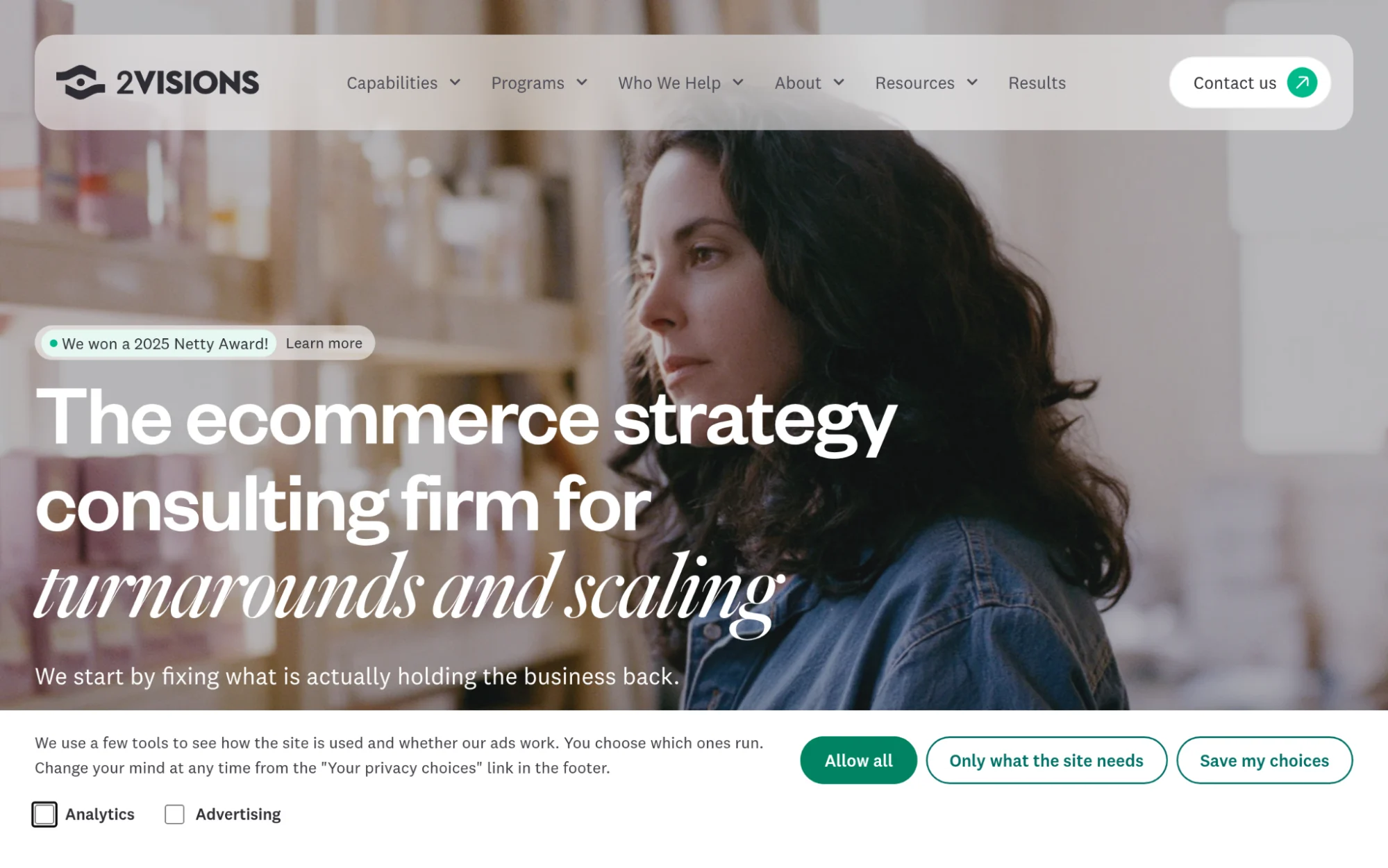
2 Vision is a DTC and B2C-focused eCommerce consultancy founded in 2017 by Yates Jarvis, who personally leads every engagement. As an eCommerce marketing consulting firm, 2 Vision takes a hands-on approach to brand positioning and growth strategy, using performance data from each client’s own operations to guide its recommendations. This single-practitioner model gives clients consistent strategic input throughout the engagement rather than passing their projects between different account managers or junior staff.
The firm works with brands generating $5M to $500M+ in annual revenue across omnichannel eCommerce, retail eCommerce, and DTC segments. Its services cover six key areas: strategic direction, research and insights, growth marketing, customer experience, operational data and analytics, and executive team development. Engagements range from a 60-day “10 Urgent Moves” project to comprehensive 12-month growth programs.
Client results reported by the firm include a $300M-per-year brand posting 47% growth year-over-year with a 31% reduction in customer acquisition cost, and a $20M-per-year brand achieving 45% DTC sales growth on an unchanged media budget. Nook, Jeep, UpWest, and Sam Ash each appear in published case studies with documented percentage lifts. 2 Vision uses a flat-fee pricing model, so scope doesn’t change the cost, and explicitly structures engagements to transfer knowledge to internal teams so the client isn’t dependent on the consultant once the work ends. The firm received a 2025 Netty Award.
2. Avensia
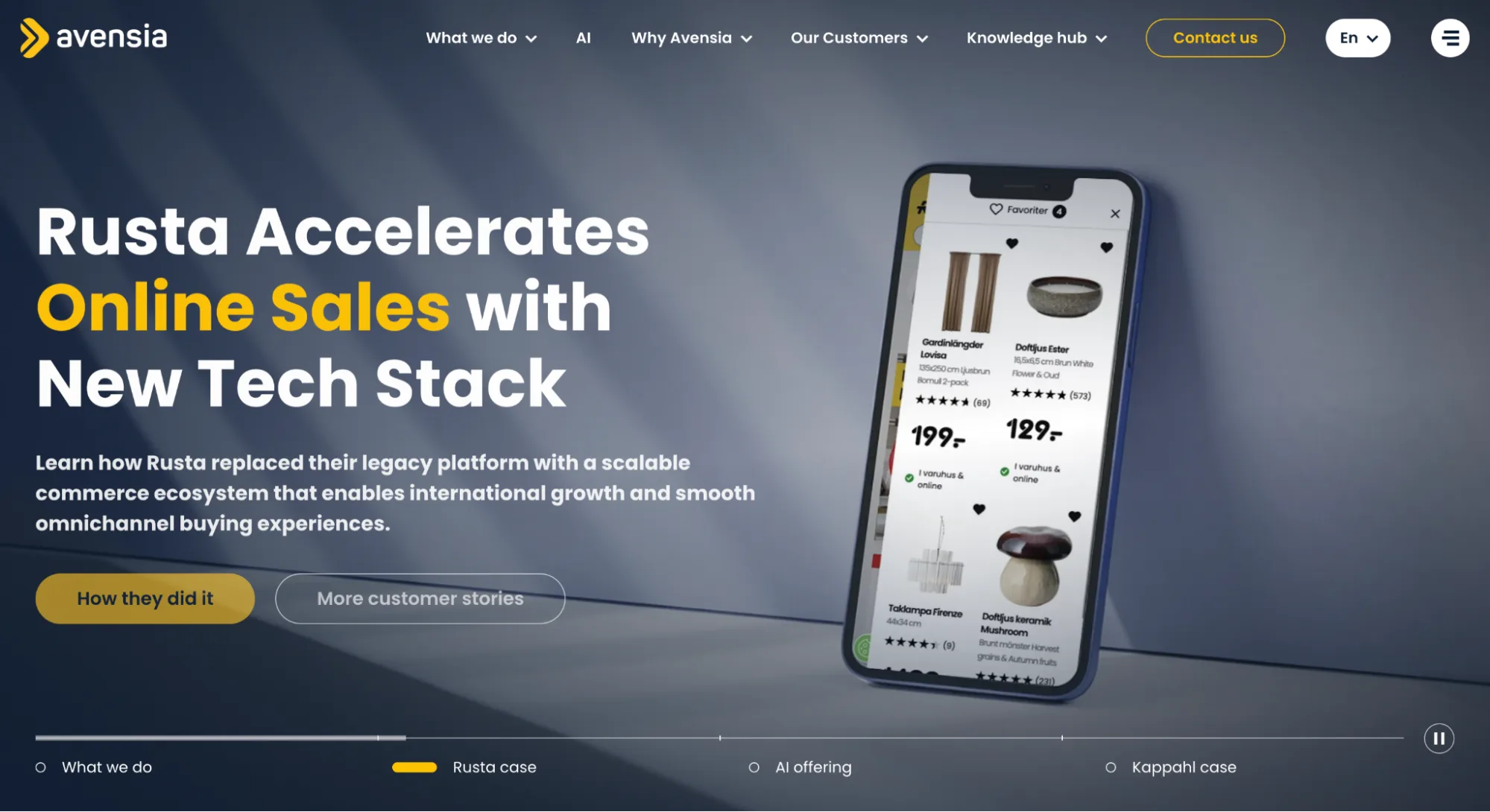
Avensia is a commerce consultancy founded in 1998 and headquartered in Lund, Sweden, with offices in the US, UK, Norway, and the Philippines. It’s publicly listed on Nasdaq First North Growth Market and employs around 300 people. The firm sits at the more technical end of the advisory spectrum, building and running commerce platforms rather than purely advising, which appeals to brands that want one partner handling both strategy and execution.
Services include eCommerce consulting, omnichannel strategy, UX and web design, loyalty and CRM programs, digital audits, and product information management. The firm provides two proprietary platforms, Avensia Nitro and Avensia Excite, along with Optimizely Commerce for D365. Its 38 partners, split between 25 technology and 13 channel partners, give clients access to a broad ecosystem of tools and integrations.
Avensia’s client base spans retail, manufacturing, wholesale and distribution, food and beverage, and healthcare. Published case studies include Kappahl, which involved a unified commerce platform with higher conversion rates, and Rusta, which centered on online sales acceleration through tech stack changes. The firm’s AI-driven commerce focus makes it especially relevant for brands planning infrastructure investments alongside marketing strategy.
3. SIA
Sia, formerly Sia Partners before a rebrand in January 2025, is a Paris-based management consulting firm established in 1999. It employs roughly 3,000 professionals across 48 offices in 19 countries, making it the largest firm on this list by headcount. Its scale suits enterprise brands that need consulting layered across multiple business units rather than a focused eCommerce engagement.
The firm calls itself a pioneer of “Consulting 4.0,” combining management consulting with AI, design, and data capabilities. Its eCommerce-adjacent services fall under marketing and customer experience, talent management, revenue management, and data science practices. Sia also runs an internal “Agent Store” launched in 2025 that delivers agentic AI applications to clients, and it puts 4% of revenue into R&D, a sign of ongoing product development rather than purely billable advisory hours.
Recognition includes the NVIDIA Partner Awards EMEA 2025 (top 3 consulting partner), an AWS Rising Star Consulting Partner of the Year award in France for 2024, and placements in Vault’s 2025 EMEA and APAC consulting rankings. Pricing isn’t publicly listed; engagements are scoped and quoted on an individual basis. Sia fits large organizations with complex cross-functional needs far better than fast-moving DTC brands that need rapid eCommerce execution.
4. Clarity
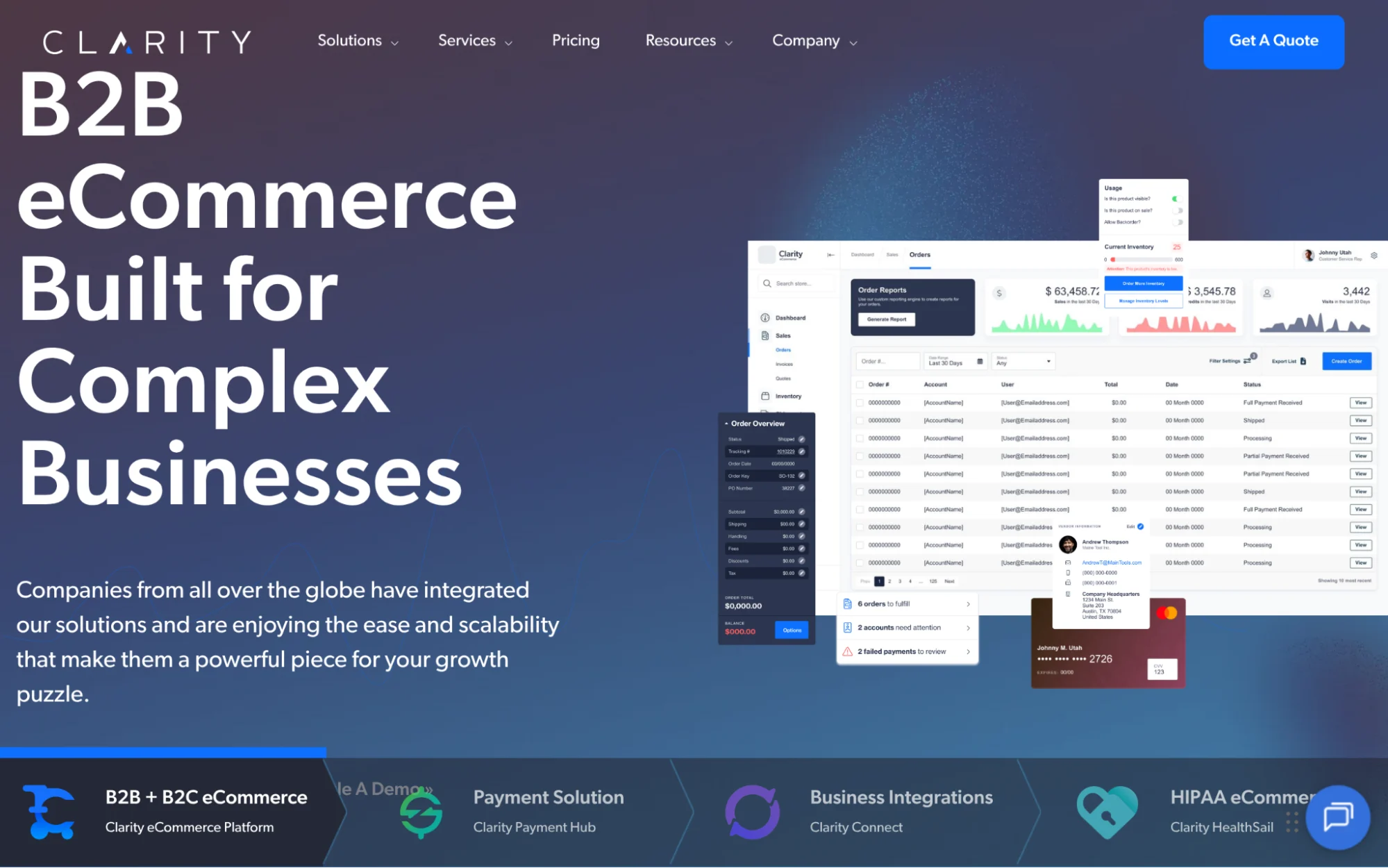
Clarity Ventures was founded in 2006 and operates out of Austin, Texas. The 64-person firm focuses on B2B eCommerce and enterprise systems, a narrower lane than most firms on this list but a genuinely deep one. Its main product, Clarity eCommerce, is a customizable B2B and B2C platform built to manage buying groups, manufacturing workflows, wholesale operations, and international commerce.
Beyond the platform itself, Clarity builds marketplace and multi-vendor tools (Clarity Marketplace), runs an auction eCommerce product, and provides Clarity HIPAA eCommerce for healthcare clients who need compliant portals. The systems side, connecting ERP, CRM, and payment systems through Clarity Connect and Clarity OpenRails AI, is where the firm differentiates from agencies that handle only the front-end experience.
The company has grown about 50% per year since its founding and has worked with clients ranging from startups to Fortune 500 companies. Pricing isn’t published; Clarity quotes custom for enterprise projects. It’s a natural fit for manufacturers, distributors, and healthcare brands that need a commerce architecture partner, not just marketing advisory.
5. Flow
Flow is a Charleston, South Carolina agency targeting SMBs and mid-market brands that need growth marketing paired with web development. The firm builds on Webflow and Shopify, runs paid media across Google and Facebook, and handles technical SEO, social media management, branded videography, and brand identity work.
The agency reports driving over $10M in client revenue through paid media campaigns, a figure that speaks to its performance focus. Its stated philosophy centers on building ecosystems that turn traffic into revenue rather than producing aesthetically strong sites that underperform commercially. Client names include American Reptile Distributors, Enflate Protective Packaging, and Castellani Law Firm, which reflects a range of industries rather than a single vertical.
Flow’s integrated model, with design, SEO, and paid media under one roof, works well for brands that don’t yet have specialized in-house marketing staff. Detailed pricing, founding year, and team size are not publicly listed on the agency’s site.
What separates a top eCommerce consulting firm from the rest
The firms that consistently deliver results share one trait: they can connect a marketing decision to a revenue outcome and explain the mechanism clearly. That sounds simple. It isn’t. Many agencies track metrics in isolation (ROAS, sessions, conversion rate) without accounting for how those metrics interact with margin, lifetime value, or operational constraints. The best advisory partners build that full picture before recommending anything.
Training internal teams matters, too. Firms that build dependency, where the client can’t function without the consultant, are structurally misaligned with the client’s interests. Firms that document processes and train internal teams leave the brand stronger after the engagement ends.
How to evaluate an eCommerce marketing consulting partner
Start with the engagement model. A firm that assigns a named strategist to every project is a different relationship than one that routes work through account managers. And a flat-fee structure changes the incentive dynamics compared to hourly billing or retainers that scale with scope.
Ask for case studies from brands in a similar revenue range and channel mix. A firm that performs well with $500M omnichannel retailers may have little relevant experience for a $10M DTC brand, and the reverse is equally true. References from clients who’ve completed an engagement, not just active ones, reveal what the relationship actually looks like once the initial period ends.
Bottom Line
The 2027 best eCommerce marketing consulting firms and advisory companies run the range from solo-practitioner specialists to global management consultancies with thousands of staff. The right fit depends on business size, the technical depth of the commerce stack, whether the need is strategic advisory or execution support, and how much internal capacity already exists. Match the engagement model to the actual problem before you start comparing service lists.