

Gaming platforms sit at one of the hardest intersections in content safety. AI Content Moderation Tools have to handle everything from toxic chat to coordinated harassment, often across dozens of languages and in real time. The false positive problem alone, where legitimate players get flagged for nothing, can tank community trust fast. After reviewing dozens of tools across the moderation space, this guide breaks down the five strongest options available right now, covering what each one does well and who it actually fits.
The research approach for this ranking:
Every tool on this list was evaluated by pulling publicly available information, including user reviews, published case studies, feature documentation from official websites, and directory-level ratings. Only platforms showing a verifiable track record inside the AI moderation space made the cut.
→ See the full research breakdown
- Utopia Analytics – Best for multi-language content moderation at scale
- besedo – Best for enterprise content moderation and user-generated content platforms
- Bodyguard – Best for enterprise content moderation and brand protection
- Alice – Best for enterprise GenAI safety and AI moderation
- Lasso Moderation – Best for content moderation for social media, gaming, and live streaming platforms
Why AI Content Moderation Tools Matter for Your Business?
Picking the wrong content moderation setup is not just a technical mistake. It directly exposes your platform to regulatory risk under DSA and COPPA, and it chips away at the trust players build over months of community participation.
The harder challenge is balance. Too aggressive, and your false positive rate climbs while real players get flagged for normal behavior. Too loose, and harmful content slips through, creating toxicity that causes users to leave.
Specialized moderation tools are built to walk that line. They’re trained on harmful content patterns in depth, which means better precision and recall scores compared to general-purpose tools that don’t have that context.
The right platform keeps your false negative rate low without inflating false positives, so your community stays clean, and your moderation team stays focused on edge cases that actually matter.
Top 5 AI Content Moderation Tools Breakdown and Comparison
Note: All data in this table is sourced from review platforms and the official websites of the listed companies.
| Company Name | Years Operating | Headquartered In |
| Utopia Analytics | Est. 2014 | Helsinki, Finland |
| besedo | Est. 2002 | Stockholm, Sweden |
| Bodyguard | Est. 2018 | Nice, France |
| Alice | Est. 2018 | New York, USA and Tel Aviv, Israel |
| Lasso Moderation | Est. 2022 | Amsterdam, Netherlands |
1. Utopia Analytics – Best for Multi-Language Content Moderation at Scale:

What Does Utopia Analytics Do?
Utopia Analytics builds machine learning tools for text analytics and AI content moderation, designed to protect online communities from abusive content, fraud, cyber threats, and spam. Founded in Helsinki in 2014, their team includes doctoral scientists and master ‘s-level professionals working at the edge of applied AI. Their flagship product, Utopia AI Moderator, is a fully automated SaaS platform that trains on human moderator decisions and reaches accuracy levels that consistently outperform manual review. The platform is language-independent and can go live in roughly two weeks, which is genuinely rare in this space.
Why Does Utopia Analytics Stand Out for AI Content Moderation Tools?
Gaming platforms dealing with multilingual communities face a specific gap: most moderation tools either drop accuracy in low-resource languages or require expensive custom builds per language. Utopia Analytics closes that gap with patented, language-independent technology that deploys fast. And honestly, the combination of sub-two-week deployment and doctoral-level AI research behind the model is the kind of technical credibility that’s hard to match at this price point.
Summary of Real User Reviews:
From what the published case studies show, major news platforms using Utopia AI have seen publishing delays cut in half and daily comment volumes jump by around 30%, all while moderation quality improved. The pattern across client results points to a platform that doesn’t just automate the easy calls but holds up on quality when content volume spikes. That kind of real-world validation, backed by $1.42M in funding and a published Ethical AI handbook, builds genuine trust.
2. besedo – Best for Enterprise Content Moderation and User-Generated Content Platforms:

What Does besedo Do?
Besedo is a hybrid content moderation platform that mixes AI trained on over 20 years of data with a team of expert human moderators. Founded in 2002, the Stockholm-based company processes billions of pieces of content every year for platforms built around user-generated content. Their SaaS product, Implio, supports more than 100 languages natively and delivers average response times under 50 milliseconds (not cheap at enterprise scale, but genuinely fast). With offices across five continents and roughly 351 staff, they bring serious operational depth to every client engagement.
Why Does besedo Stand Out for AI Content Moderation Tools?
Gaming platforms with massive content volume need a moderation stack that can absorb volume spikes without degrading accuracy. Besedo’s two-decade training dataset gives their models a contextual depth that newer entrants simply don’t have yet. Clients like eBay and OLX don’t choose a partner like this without seeing real precision gains at scale, and that client roster is a strong signal.
Summary of Real User Reviews:
Besedo’s reputation as a trusted moderation partner comes through clearly across reviews, with recurring praise for their accuracy and the cultural nuance their human-AI hybrid brings to edge cases. Clients highlight that the combination reduces the false negative rate on subtle policy violations without pushing false positives up. The 351-person team size and $39.4M in revenue suggest this isn’t a company that overpromises on capacity.
3. Bodyguard – Best for Enterprise Content Moderation and Brand Protection:

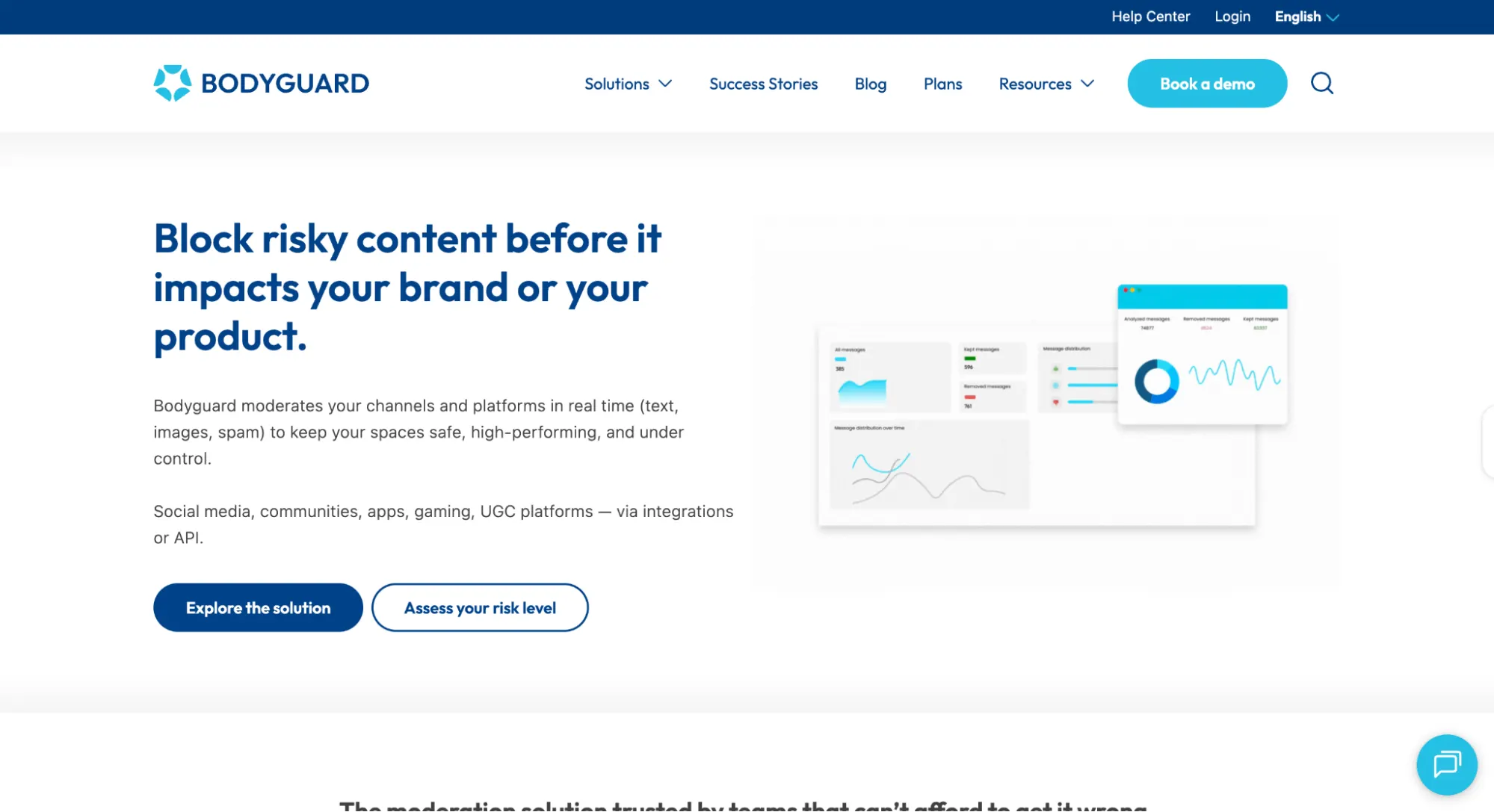
What Does Bodyguard Do?
Bodyguard is a content protection platform founded in Nice, France in 2018, built to detect and remove toxic and illegal content across text, images, and video. The platform serves consumer brands, gaming companies, sports organizations, luxury brands, and media firms, which gives it a diverse real-world training profile. Their tools include real-time moderation, customizable rule sets, automated workflows, and optical character recognition for catching text embedded in images (a common evasion tactic in gaming environments). Clients include Alfa Romeo F1 Team Stake and French broadcaster M6, which signals enterprise-level trust.
Why Does Bodyguard Stand Out for AI Content Moderation Tools?
Most moderation tools focus on text-only pipelines. But gaming platforms generate harmful content across chat, images, and video simultaneously, and Bodyguard’s multi-modal detection covers all three in real time. Their use of experienced linguists alongside the AI layer keeps context-dependent content decisions more accurate than a purely automated approach would manage on its own.
Summary of Real User Reviews:
Bodyguard doesn’t have a deep pool of public reviews yet (a natural limitation for a six-year-old company targeting enterprise deals), but the $11.4M in funding and recognition through the For Democracy Talent Award point to a company gaining serious industry traction. From what’s publicly available, the enterprise client wins suggest their precision on brand-safety content categories is already at a level that major organizations trust. That kind of early momentum is worth watching.
4. Alice – Best for Enterprise GenAI Safety and AI Moderation:

What Does Alice Do?
Alice is an enterprise AI security and safety platform purpose-built for organizations developing GenAI applications, AI agents, and foundation models. Their WonderSuite product family covers the full lifecycle: WonderBuild handles adversarial testing before launch, WonderFence provides a real-time AI firewall at runtime, and WonderCheck monitors content after deployment. The proprietary Rabbit Hole dataset, built from billions of continuously updated toxic examples, powers sharper classifiers and stronger red-teaming capabilities than most competitors can put together. Alice protects over three billion users across 120-plus languages (think serious enterprise infrastructure here).
Why Does Alice Stand Out for AI Content Moderation Tools?
Gaming companies building advanced features or generative NPCs face a new category of safety risk that standard moderation tools weren’t designed to address. Alice’s lifecycle-wide coverage is built for exactly that gap. Being trusted by NVIDIA, Amazon, TikTok, and The New York Times, while holding both SOC 2 and ISO 27001 certifications, puts their claims well past the “just marketing” level.
Summary of Real User Reviews:
Alice’s client list reads like a who’s-who of tier-one technology companies, and that pattern tells most of the story. When NVIDIA and Amazon are deploying the same platform, you can reasonably assume the adversarial testing capabilities hold up under serious pressure. Their dual certifications and cross-industry deployments reinforce that this isn’t a single-use niche tool but a full-coverage safety stack for organizations where AI moderation failures carry real consequences.
5. Lasso Moderation – Best for Content Moderation for Social Media, Gaming, and Live Streaming Platforms:
What Does Lasso Moderation Do?
Lasso Moderation is a content moderation platform founded in Amsterdam in 2022, designed to automate 99% of moderation tasks while routing the remaining 1% to a human dashboard for review. The platform detects spam, toxicity, nudity, violence, and drug-related content across chat, video, and social media channels. It connects natively with Discord, Facebook, Instagram, Slack, and X, making it one of the more immediately deployable options for gaming communities already living on those platforms. For a two-year-old company, a 4.9 rating as the highest-rated platform in its category is a strong opening statement.
Why Does Lasso Moderation Stand Out for AI Content Moderation Tools?
Gaming and live streaming environments produce content at a pace that overwhelms manual review within minutes. Lasso’s 99% automation rate directly addresses the human escalation rate problem that burns out moderation teams fast. Their human dashboard for edge cases keeps the approach grounded, so policy coverage breadth doesn’t come at the cost of context-dependent judgment calls.
Summary of Real User Reviews:
Lasso Moderation carries a 4.9 rating, and the consistent thread across reviews is that the automation genuinely holds up without generating a flood of false positives. Users appreciate that the 1% human escalation model keeps their teams focused on real edge cases rather than drowning in low-confidence flags. For smaller gaming operations or mid-sized streaming platforms, this kind of lean, high-accuracy setup is a practical starting point.
Research Methodology and Selection Process:
Selecting the right tools for this list required more than a surface-level scan of product pages. The goal was to surface platforms with real-world performance evidence specific to AI content moderation, not just vendors with polished marketing copy.
Initial Data Collection:
The process started by casting a wide net across content moderation directories, software review platforms, and published case studies from the past several years. Company profiles were pulled from multiple sources to build a baseline longlist of platforms operating in the AI moderation space. Priority was placed on tools with documented use cases across gaming, social platforms, live streaming, and user-generated content environments, since those contexts share the most overlap with the demands gaming platforms face.
Shortlisting Phase:
From the initial longlist, platforms without verifiable operational history were removed early. Review patterns were analyzed across multiple platforms to identify whether positive signals were broad and consistent or narrow and sporadic. Tools that showed up repeatedly in peer discussions, trust and safety forums, and buyer comparison threads moved forward. Platforms with thin public footprints or unverifiable claims were set aside regardless of how their own sites described them.
Verification of Claims:
Each shortlisted company’s stated capabilities were cross-referenced against independent sources. Where a company claimed specific accuracy rates, language coverage, or response time benchmarks, those claims were checked against client testimonials, published case studies, and third-party write-ups. Real-world results from named clients carried more weight than product descriptions alone. Discrepancies between what a company claimed and what external sources reflected were flagged and factored into the final assessment.
Authority and Industry Contribution Layer:
Beyond product capability, each company was evaluated for signals of broader credibility. This included industry award recognition, citations in trust and safety publications, funding history, and whether the company had contributed original research, frameworks, or public resources to the moderation field. Publishing an Ethical AI handbook, earning independent certifications, or winning recognized industry awards all pointed toward companies that take their position in the space seriously.
AI Content Moderation Tools-Specific Evidence:
The final layer focused on moderation-relevant depth. Each platform was assessed for dedicated service pages covering major violation categories, verified reviews from trust and safety practitioners, and case studies showing measurable outcomes such as changes in false positive rates, human escalation rates, or content volume capacity. Platforms that could demonstrate concrete moderation results, not just general capability, cleared this stage. Those who couldn’t were excluded from the final list.
How to Choose the Right AI Content Moderation Tools:
Choosing a content moderation platform for a gaming environment is not a one-size-fits-all decision. Gaming communities generate high-volume, fast-moving content across multiple channels, so the tool has to fit the specific shape of that problem.
- Industry/Domain Experience: Look for platforms with documented work in gaming, live streaming, or social environments. Domain context shapes how models handle slang, in-game language, and community-specific behavior patterns.
- Features and Service Range: Check whether the platform covers the content types your platform generates, such as text, images, video, and audio. Multi-modal coverage matters more for gaming than most other verticals.
- Pricing Structure: Moderation costs scale with content volume, so understand whether pricing is per-request, per-seat, or flat SaaS (think enterprise pricing for high-volume platforms). Make sure the model fits your growth curve.
- Results Measurement: Any serious vendor should be able to share precision and recall benchmarks, average moderation response time, and human escalation rate data. If they can’t, that’s a gap worth probing.
- Industry Knowledge and Compliance: Confirm the platform supports your DSA, COPPA, and NetzDG obligations. Regulatory coverage should be a baseline requirement, not a premium add-on.
Bottom Line:
The AI content moderation space has matured fast, and gaming platforms now have real options built for their specific demands. Utopia Analytics brings language-independent AI with rapid deployment. Besedo brings depth from two decades of training data. Bodyguard covers multi-modal content. Alice targets GenAI-specific risk. Lasso handles high-volume automation with a lean team footprint. Matching the right tool to your platform’s scale, language mix, and content types is where the real decision lives.