
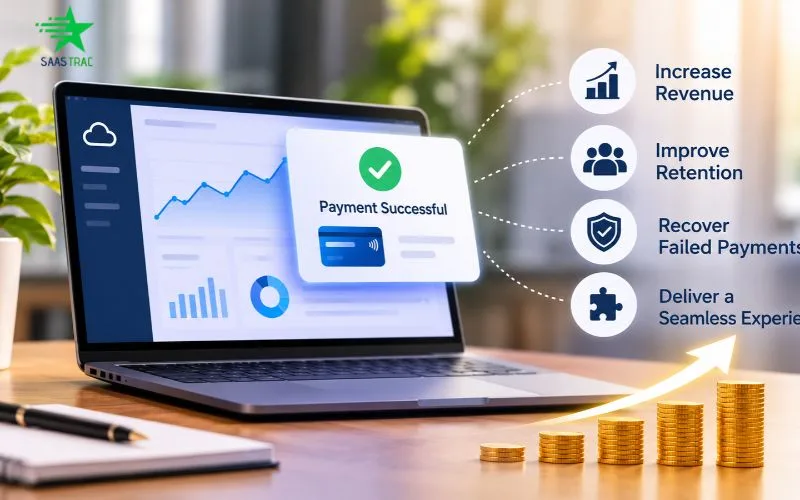
US customers spent $1.7 trillion through payments embedded in non-financial software and products in 2021, according to Bain & Company, and the companies that embedded those payments earned about $12 billion in net revenue from them. Sending customers to a separate processor gives up a share of that revenue and leaves a core workflow outside the SaaS product.
Revenue per Account
Subscription pricing caps what a SaaS company earns from a customer at the plan price. Payment revenue grows with the customer’s own sales. In a September 2026 brief, Bain estimated that software platforms with embedded payments typically keep 20 to 30 basis points of the volume they process, compared with 5 to 15 basis points for platforms that refer customers to an outside processor.
Take a salon management product priced at $89 a month. If one salon processes $60,000 a month in client payments through it, the product earns about $150 a month from payments at 25 basis points. The payment line is larger than the subscription, and it rises when the salon has a busy month without any change to the plan.
Bain’s example of a company facilitating €500 million in annual transactions put the incremental revenue at €1.0 million to €1.5 million once the company moved from referral fees to an embedded model, with no increase in volume.
Retention and Switching Costs
A customer who processes payments inside a SaaS product has more to move if they leave. Saved customer cards, recurring billing schedules, payout history and reconciliation reports are all stored in the same system, and migrating them to a new vendor risks failed charges during the move. That friction tends to lengthen customer lifetimes. After a year on the payment feature, the customer has also built reports and staff routines around it, and a competing vendor would need to replace all of them.
Retention gains depend on payout speed and on how holds are handled. A slow payout schedule or an unexplained hold on funds gives customers a reason to leave, and they blame the software company, since its name is on the screen. New merchants usually ask about payout timing first, so the signup flow should state it plainly.
Recovery of Failed Subscription Charges
SaaS companies also lose revenue on their own billing when a customer’s card expires or is declined. These failed charges are a form of involuntary churn, because the customer did not decide to cancel. Bain estimated that platforms can regain 1% to 2% of annual recurring revenue by reducing involuntary billing churn and recovering failed payments.
Card updater services refresh expired card numbers automatically, and retry logic schedules a second attempt at a time when the charge is more likely to be approved. Running its customers’ payments usually gives the SaaS company these tools for its own subscription billing as well.
Build Options for a Payment Offering
A SaaS company has three broad ways to add payments, and they differ mainly in who does the regulatory work. The lightest option is a referral partnership, which pays the least. The heaviest is full facilitation, where the software company underwrites its own merchants and answers to a sponsor bank. Between the two, many companies build on a payment facilitator platform for PayFacs, leaving underwriting and fund flows to that partner while keeping pricing decisions in-house.
Companies that want payment revenue in the first year without hiring a full risk department often start with this middle option. It also leaves room to take on more of the work later as volume grows.
Launch Sequencing
Many SaaS companies start with card acceptance for one customer segment and invite 20 or 30 existing customers into a pilot. Before a wider launch, they track the attach rate, meaning the share of invited customers who turn payments on, and the support load per active merchant in the first 60 days.
If the attach rate is low, the usual causes are pricing that looks worse than the customer’s current processor or onboarding forms that demand too much effort before the first payment. Both can be fixed before the offering reaches the full customer base.
Product Data From Transactions
Payment records give a product team a detailed view of each customer’s business. Processing its customers’ payments shows a software company the seasonal swings in each customer’s revenue, the share of sales that arrive late, and which features precede higher volume. That information supports cash flow reports inside the product and, for some companies, merchant cash advances priced on real sales history.
The data also helps sales teams. Sales teams can price a bundle around each prospect’s payment volume. At $2 million a year, that volume is worth more to the business than the plan price.
Operating Costs and Risk
Integrated payments add new work to a SaaS company. Support staff need training on deposits and chargebacks. A risk team, or a partner’s risk team, has to review new merchants and watch for fraud patterns. Finance needs to reconcile the payment revenue line and account for losses when a merchant cannot cover a chargeback. A partner can take on much of this work at first, although the software company still answers to its customers when a payout is late.
A company with low payment volume per customer may find that the revenue gain does not cover the staff and losses until the customer base grows enough to produce economies of scale. Referral models are still common among companies in that position.
Pricing the Payment Offering
Customers compare payment rates with what they paid before. A SaaS company can offer a flat rate that is simple to explain or an interchange-plus rate that passes through network costs and adds a fixed margin. Flat rates usually produce more revenue on small transactions, while interchange-plus pricing is easier to defend with larger customers who have negotiated rates in the past. A third structure charges a monthly platform fee in exchange for lower per-transaction rates, and it costs less overall for customers with high, steady volume.
Whichever model is chosen, monthly statements should show each fee by type, so the customer can see what they paid and why. Statements that customers can read without calling support also give them less reason to shop the rate elsewhere.
The Cost of Leaving Payments to Others
Leaving payments to others still costs a SaaS company money. The cost comes in referral fees that are a fraction of what an embedded model would earn, in subscription revenue lost to expired cards, and in customers who leave for a competitor whose product already processes their payments. On a customer base processing $300 million a year, the 15 basis point gap between a 10 basis point referral fee and a 25 basis point embedded margin comes to $450,000 a year in revenue the company does not book.