

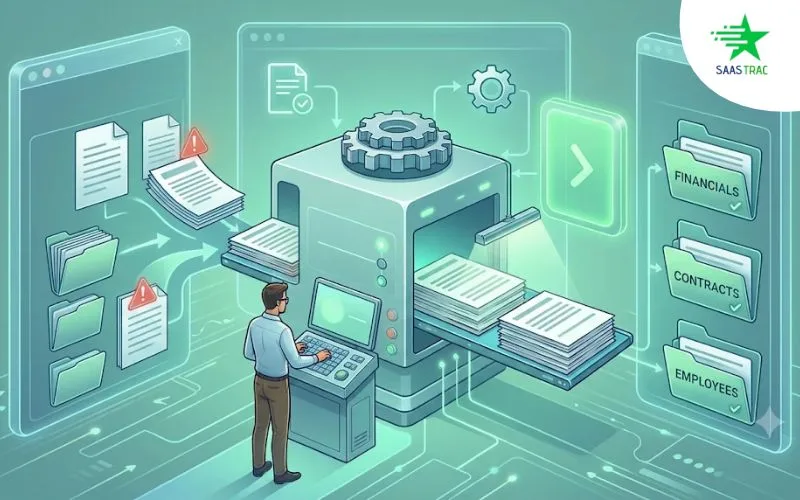
In many deals, redaction happens one document at a time. Whoever prepares a file decides what to black out, with no written standard to guide the call. The result is an uneven set of documents. One contract arrives with prices hidden, a near-identical one arrives untouched, and a third never shows up. Reviewers notice these gaps and start asking questions.
Both errors carry a cost. Over-redaction slows the review and frustrates the counterparty. Under-redaction can expose information the seller never meant to share.
This article makes the case for a defined redaction workflow, set up before any file goes into the data room. It covers what to redact, what to withhold, and how to apply the same rules across a large file set. Done early, this makes due diligence document preparation faster and easier to defend.
Why redaction needs a defined standard, not case-by-case judgment
A defined standard gives every document the same treatment, which case-by-case judgment can’t do. Three problems show up when teams skip it:
- Inconsistent redaction across a document set signals disorganization and invites extra scrutiny from the reviewing party.
- Over-redaction slows review and can prompt follow-up questions about what you’re withholding.
- Under-redaction risks disclosing competitively sensitive or personally identifiable information that should never have left the organization.
A standard also helps the other side. Reviewers learn what a redaction mark means in your data room, so they spend less time guessing and more time analyzing the business. Your confidential information memorandum sets expectations too. It tells buyers what level of detail to expect. If redacted files show far less detail than that memorandum suggested, reviewers will ask why, and answering takes time.
What categories of information typically need redaction
Four categories cover most redaction decisions. Redacting sensitive documents is easier when you know what to look for before you open the first file.
- Personally identifiable information in HR, customer, or vendor records that isn’t relevant to the transaction.
- Pricing or contract terms with specific counterparties that could create competitive exposure if shared broadly.
- Information covered by third-party confidentiality obligations that the seller isn’t authorized to disclose.
- Privileged legal communications that appear inside an otherwise disclosable document.
The first category deserves extra care. According to a September 2025 Abcoo Law Firm article on Mondaq, many data protection laws require companies to share only personal data that is adequate, relevant, and limited to the purpose of the deal. The same article notes that excessive disclosure can attract regulatory attention. Ask counsel to confirm which rules apply to your transaction.
Privileged communications need the most care. Sharing a privileged email, even by accident, can put that protection at risk. Counsel should review any file that may contain one before it moves forward.
Deciding what to redact versus what to withhold entirely
Redact a document when it’s relevant and disclosable but contains a few fields the buyer doesn’t need. Withhold it when its core content is itself sensitive. Two questions help you choose: does the buyer need this document to judge the deal, and can the sensitive part be removed without changing what the document says? The table shows the split.
| Decision | When it fits | Example |
| Redact | The document is relevant, and only specific fields are sensitive | An employment agreement with the employee’s home address and ID number removed |
| Withhold | The document’s core content is sensitive | A key customer contract held back until a later review stage |
A withheld file doesn’t have to stay out for good. Teams often release such files later through staged access in an M&A data room, once a bidder reaches the right stage.
Whichever route you choose, write down the reason. Record who made the call, the date, and the rule behind it. If a buyer questions a gap later, you can answer in minutes instead of reconstructing the decision. Before upload, schedule a sensitive document review M&A counsel can approve, so each decision gets a second check.
Building a consistent redaction workflow across the document set
Consistency comes from three habits:
- Define redaction categories upfront. Keep a short list of information types that always get redacted, so nobody makes the call fresh for each file.
- Assign one reviewer or a small team. They apply the standard across the full document set, which keeps results uniform.
- Use tools built for the job. Manual methods can leave metadata or underlying text recoverable.
For the third point, choose document redaction software that deletes content rather than covering it. A technical poster from PDF Days Europe 2025, published by the PDF Association, states that legal-grade redaction must remove text, metadata, annotations, and embedded objects, not just mask them visually. A black box drawn over a line of text fails that test. Before you apply any tool to the full set, run it on a small batch of files and check the results.
Staging redacted materials for the review process
Data room document preparation doesn’t end when redaction does. Staging comes next, and it needs the same discipline.
- Organize redacted versions alongside the rest of the document set in the data room used for the deal, not as a separate batch tracked informally.
- Confirm that your platform removes redacted content rather than overlaying it, since some methods leave the underlying text extractable.
- Track which documents have finished redaction review and which are still pending, so incomplete files don’t get uploaded early.
- Test a few redacted files by searching for a redacted term and trying to copy text from the marked area. If anything appears, fix the method before you upload more.
Conclusion
Redaction works best as a set of rules, not a series of judgment calls. Define your categories before you open the first file. Decide in advance which documents get redacted and which stay out, and record why. Assign a small team to apply the rules, and use tools that delete content rather than hide it. Finally, stage redacted files with the rest of the set and track what’s still pending.
These steps cut follow-up questions, protect information the seller never meant to share, and give reviewers a set they can trust. Clear rules also protect your team when a buyer asks why a document looks the way it does. Before your next deal, draft your redaction categories and test them on a few sample files.