


What Is Elixir and Why Is It Gaining Popularity?
Elixir is a functional programming language built on top of the Erlang virtual machine, designed to handle applications that need to stay online and responsive under heavy load. Created by José Valim in 2011, it borrows the reliability of Erlang’s telecom-grade architecture while offering a syntax that feels approachable to developers coming from Ruby or Python. Over the past decade, more companies have turned to Elixir as their traffic grew and older stacks began to strain under the weight of concurrent users. Its growing adoption is driven by a simple demand: teams want a language that can process thousands of simultaneous connections without falling over. This article looks at what sets Elixir apart, where it fits best, and what to weigh before adopting it for a new project.
What Makes Elixir Different from Other Backend Languages?
Most backend languages were not built with massive concurrency in mind, and it shows once traffic spikes. Elixir takes a different route by running on the BEAM, the same virtual machine that powers Erlang, which was originally developed for telephone switches that could not afford downtime. This heritage gives Elixir a process model where thousands of lightweight processes run independently, isolated from one another, so a failure in one does not bring down the rest.
On top of this foundation sits a functional programming style. Instead of mutable objects and shared state, Elixir works with immutable data and pure functions, which reduces the kind of bugs that come from unexpected side effects. Pattern matching, a feature borrowed from Erlang, lets developers write cleaner logic for handling different data shapes without long chains of conditional statements. The combination of a battle-tested runtime and a modern functional syntax gives Elixir a distinct position among backend options.
Key Benefits of Using Elixir for Backend Development
Elixir’s design choices translate into practical advantages once an application moves from prototype to production. Companies building products that need to stay available around the clock find that the language’s core strengths map directly onto their operational needs. What looks like a set of language features on paper turns into measurable operational gains once real users start hitting the system at scale. Teams that switch to Elixir often report fewer late-night outages and less time spent firefighting production issues, since the language was built from the start to expect failure rather than treat it as an exception. This matters most for businesses where downtime carries a direct cost, whether that means lost transactions or frustrated users.
Scalability and Fault Tolerance with the BEAM Virtual Machine
The BEAM allows an Elixir application to spread work across multiple CPU cores automatically, without the developer writing custom threading logic. Processes on the BEAM are cheap to create and destroy, so an application can spin up millions of them without exhausting system resources. If one process crashes, supervisor trees built into the OTP framework can restart it in isolation, keeping the rest of the system untouched. This “let it crash” philosophy sounds counterintuitive at first, but it shifts the burden of error handling away from defensive coding and toward structured recovery, which tends to produce more stable systems over time. Teams without prior BEAM experience often choose to hire remote Backend developer talent for the first phase of a project, since the process model requires a different approach to debugging and system design than most mainstream frameworks.
High Concurrency for Real-Time Applications
Real-time features such as live notifications, chat windows, and collaborative editing require a backend that can hold open thousands of connections at once. Elixir handles this naturally because each connection can be represented as its own lightweight process rather than a thread competing for limited system resources. Phoenix Channels, built specifically for this purpose, make it straightforward to push updates to connected clients the moment new data arrives, rather than relying on repeated polling. This makes Elixir a practical fit for products where users expect information to update instantly.
Elixir vs. Other Backend Technologies (Node.js, Ruby, Python)
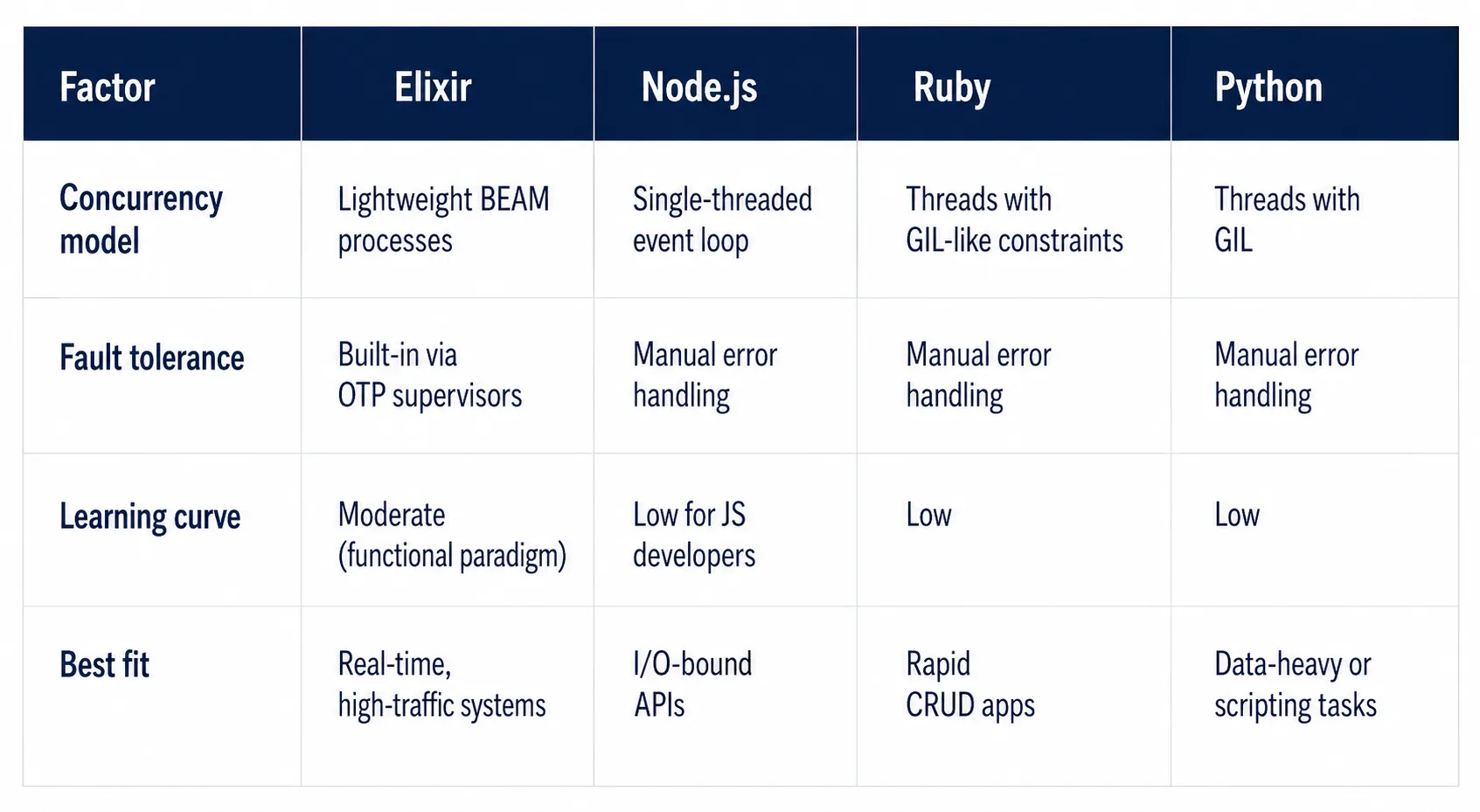
Choosing a backend language often comes down to comparing trade-offs rather than finding a universal winner. Node.js handles concurrency through an event loop and non-blocking I/O, which works well for many web applications but can struggle when a single process becomes a bottleneck under sustained load. Ruby, particularly with Rails, offers fast development speed and a mature ecosystem, though it typically requires more infrastructure to scale horizontally. Python remains a strong general-purpose choice, especially for teams already invested in data science or machine learning workflows, but its concurrency model has historically lagged behind Elixir’s process-based approach.None of these languages is objectively superior across every scenario. The right choice depends on the specific demands of the application, the size of the team, and the existing technical background of the people who will maintain the codebase.
Best Use Cases: When to Choose Elixir for Your Web Application
Elixir performs best in scenarios where reliability and concurrent connections matter more than raw development speed. Some of the strongest fits include:
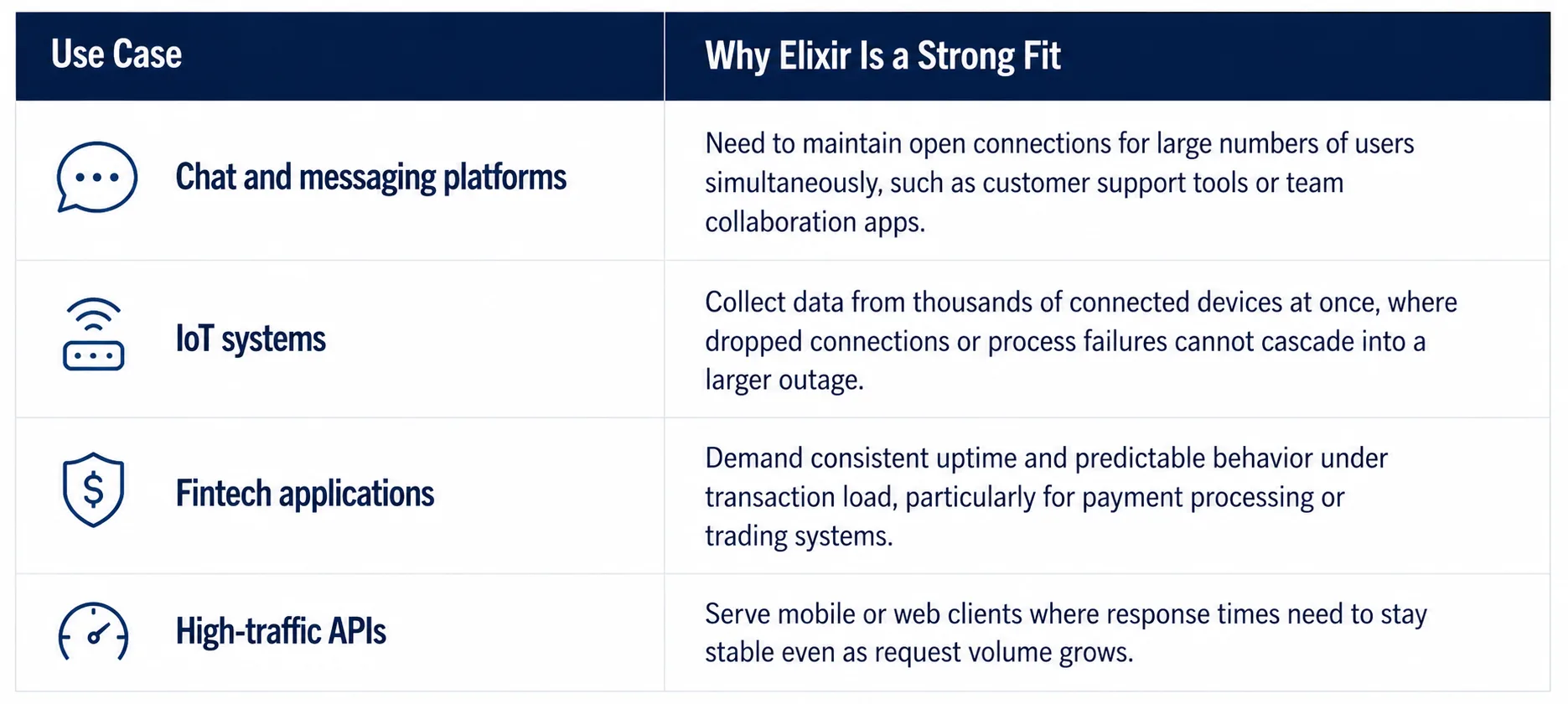
For teams building any of these systems, bringing in an experienced Elixir developer for hire can shorten the learning curve considerably, since the functional paradigm and OTP concepts differ enough from mainstream object-oriented languages that in-house teams often need guidance during the first few months.
Popular Companies and Frameworks Using Elixir (Phoenix Framework Overview)
Several well-known companies have adopted Elixir for parts of their infrastructure, including Discord, which uses it to handle millions of concurrent voice and text connections, and Pinterest, which relies on it for notification delivery at scale. WhatsApp’s earlier reliance on Erlang, the language Elixir builds upon, also demonstrates how the underlying BEAM runtime has already proven itself in messaging systems handling enormous user bases.
Phoenix is the framework most closely associated with Elixir web development. It provides a structure similar to Rails or Django but adds native support for real-time features through Channels and LiveView, the latter allowing developers to build interactive interfaces without writing separate JavaScript for many common use cases. Phoenix’s popularity has grown alongside Elixir itself, and it remains the default starting point for most new Elixir backend projects.
Challenges and Considerations Before Adopting Elixir
Elixir is not without trade-offs. The functional programming model requires a shift in thinking for developers used to object-oriented patterns, and the hiring pool remains smaller than for languages like JavaScript or Python. Teams considering adoption should weigh:
- The time needed to train existing staff or the cost of finding specialized talent.
- Library and package availability, which, while growing, is still narrower than more established ecosystems.
Weighing these factors early tends to prevent costly missteps once a project is already underway, particularly for teams that plan to scale the application well beyond its initial release.
Conclusion: Is Elixir the Right Choice for Your Next Project?
Elixir suits projects that demand high concurrency, predictable uptime, and the ability to recover gracefully from failures. It is not the fastest language to pick up, and its ecosystem is smaller than some alternatives, but for real-time features, IoT platforms, and systems that cannot afford downtime, it offers advantages that are difficult to replicate elsewhere. Before committing, weigh your team’s current skills, the specific demands of your application, and how much value fault tolerance brings to your particular use case. For the right project, Elixir provides a foundation built for resilience rather than one that simply survives until the next traffic spike.