


Businesses may have several finance tools. They do this to make their work more efficient. They have solutions for each of the tasks, such as accounting, payroll, and expense management. Companies purchase this software from different vendors at different times. This is why most of the software does not share data automatically and is not integrated.
Isolation in finance systems wastes time transferring data between applications. This slows down business operations and complicates the picture of the company’s finances.
Adding more software isn’t the solution. Businesses require a connected system to collect all the information in one secure place. This is where a finance tech stack comes in.
It’s more than a collection of software. It’s a blend of applications, integrations, and workflows that are right for the job and designed to streamline routine tasks. It also enhances collaboration and provides finance teams with visibility to make better decisions.
In this guide, we’ll look at the essential tools that make up an effective finance tech stack and key considerations when choosing them.
Why Your Finance Tech Stack Matters More Than Single Software?
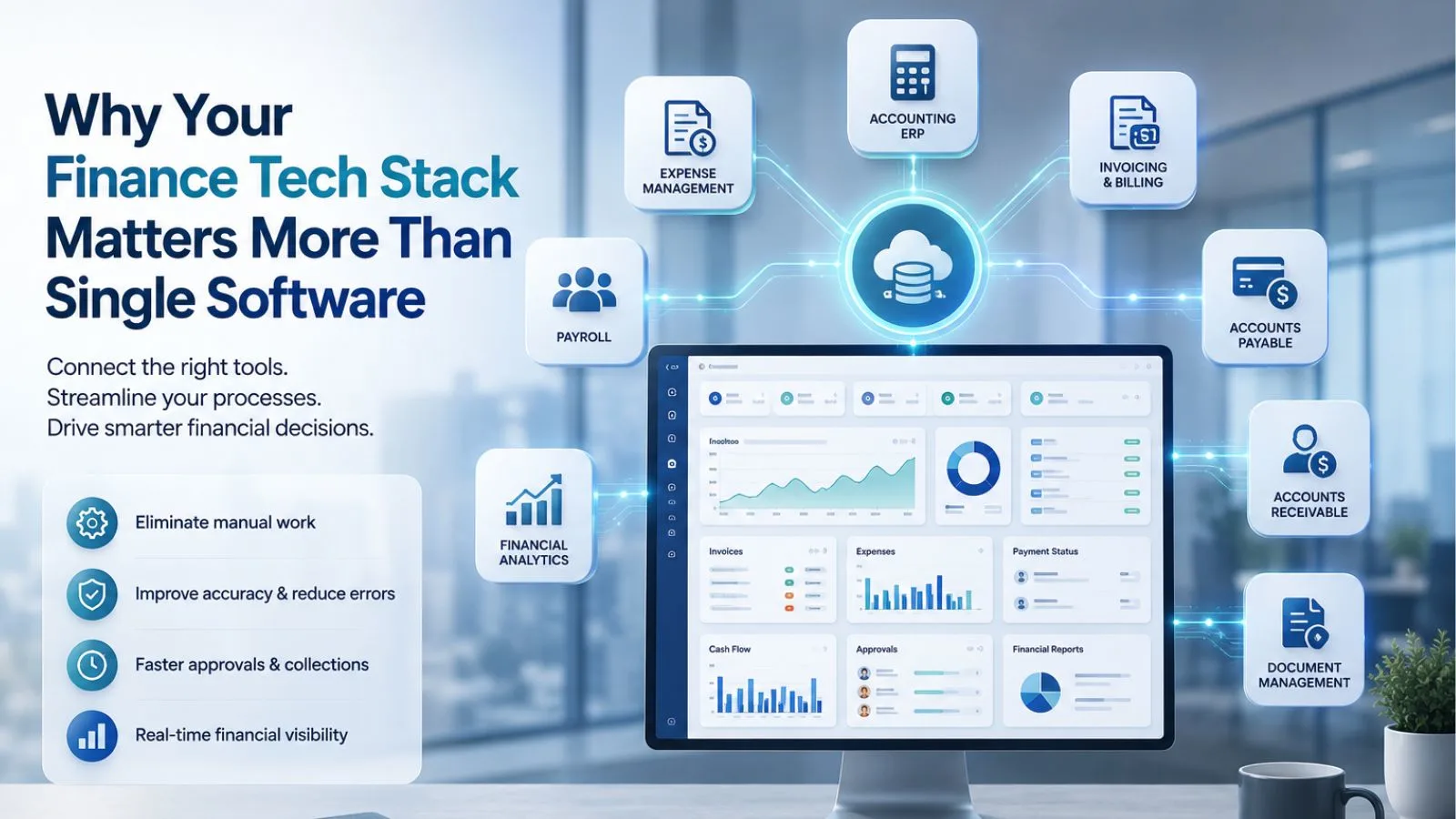
A finance tech stack integrates various tools such as accounting ERP, expense management and billing systems to streamline data flow. It is not just a bunch of applications related to finance; it works to support the financial system of a business.
Without this connected approach, finance teams often spend hours moving data between systems. They also waste time correcting errors caused by duplicate or outdated information.
In this way, approval processes become slower, and invoice collections take more time than expected. As a result, companies lose valuable time and struggle to make decisions based on accurate financial data.
A well-built finance tech stack eliminates these inefficiencies by connecting the right software. It automates repetitive tasks and makes the workflow consistent. It streamlines financial processes and improves visibility across finance operations. As a result, finance teams can focus on higher-value work instead of repetitive administrative tasks.
7 Essential Tools Every Modern Finance Team Should Have:
A strong finance tech stack uses multiple specialized tools instead of only one. By working together, these tools work together and save your time. Each tool performs a specific task, and when they work together, they reduce manual work in your business.
Here are the 7 software categories every finance team should consider when building a tech stack. It saves time and improves efficiency.
1. Accounting software:
Accounting software works as a foundation of every finance tech stack. It helps businesses manage their ledger entries, track income, reconcile bank transactions, and stay compliant with tax requirements.
When you plan to choose an accounting software, look for features such as automated bank reconciliation, financial reporting, integration with payroll, expense management, and accounts payable systems.
Popular accounting platforms include:
- QuickBooks Online
- Xero
- Sage Intacct
- NetSuite
Also Read
Is FreshBooks A Good Free QuickBooks Alternative?
2. Expense management software:
Tracking business expenses manually is a time-consuming task, and there is a risk of errors. This software simplifies the process by allowing employees to submit expenses digitally and upload receipts. Many platforms also have a function to sync expenses directly from accounting software. It reduces duplicate data entry.
Common expense management tools include:
- Expensify
- SAP Concur
- Ramp
- Brex
3. Payroll software:
Payroll software manages tax calculations, deductions, and compliance requirements. It helps businesses process salaries of their employees on time and accurately. Many payroll platforms provide employee self-service portals and allow staff to access pay stubs.
Payroll software saves time and helps businesses stay compliant while improving the employee experience.
Popular payroll solutions include:
- ADP
- Paychex,
- Rippling
4. Accounts payable automation software:
Accounts payable automation software simplifies the entire invoice payment process. It captures invoices digitally, schedules vendor payments, and maintains payment history. Automating such tasks helps businesses reduce processing time and minimize late payment fees.
Leading accounts payable tools include:
- Bill.com
- Tipalt
- Stampli
- AvidXchange
5. Accounts receivable automation software:
Accounts receivable automation software helps businesses generate invoices and send automated payment reminders. It also offers other features like tracking outstanding balances and providing customers with convenient payment options.
These features improve payment collection and reduce manual follow-ups required from finance teams.
Popular accounts receivable platforms include:
- HighRadius
- Bill.com
- Upflow
- Versapay
6. Financial reporting and analytics tools:
Financial and analytics tools help businesses understand their financial performance. They collect data from different systems and turn this data into an easy-to-read dashboard, reports, and charts.
Business owners can easily track cash flow and compare budgets with actual spending without spending hours on spreadsheets.
Common reporting tools include:
- Microsoft Power BI
- Looker
- Fathom
7. Document management software:
Document management software helps businesses store and organize important financial documents in one place. The finance team can quickly find, share, and update files like invoices, contracts, tax records, and purchase orders. It also keeps documents secure by providing access restriction options.
Popular document management tools include:
- Microsoft SharePoint
- Google Drive
- Dropbox Business
- DocuWare
Also Read
Bit.ai Review- Why Bit is the Ultimate Document Management Software?
How Integrations Turn Individual Tools into a Finance Ecosystem:
Having good finance software isn’t enough until it is integrated with other software. When accounting, payroll, and expense management work together, information flows automatically from one application to another. It reduces manual work and keeps financial records accurate in a secure place.
For instance, approved expenses can appear in accounting software. Similarly, payroll information, invoices, and payment records are also shared between systems so finance teams don’t have to enter the same data repeatedly. This is how individual systems turn individual tools into a finance ecosystem.
Automation Has Its Limits:

Finance software can automate many routine tasks like invoicing, payment reminders, and payment tracking, but it cannot handle every situation. Some tasks still require human judgment and communication. For example, billing disputes, payment negotiations, and overdue accounts often require direct communication and thoughtful decision-making.
A finance professional can understand the concerns of the customers, discuss payment options, and provide solutions to maintain a positive and long-term relationship. Together, technology and human expertise create a more effective collections process.
6 Best Practices for Building a Finance Tech Stack That Scales:
Choosing the right software is only the first step. To get the most value from your investment, your financial tools should grow with your business.
Following these best practices can help you build a finance tech stack that stays efficient, connected, and easy to manage as your company expands.
Identify the biggest financial constraint:
If late payments and collections are slowing cash flow, software can automate reminders, but recovery often requires consistent follow-up. Many businesses support their accounts receivable process with virtual collections specialists to manage overdue accounts while their finance team focuses on higher-priority work.
Prioritize software that integrates:
Before choosing the new tool, make sure it can be integrated with the software you already use. These integrations reduce manual data transfers, minimize errors, and ensure information stays consistent across your finance systems.
Look for automation features:
Choose software that automates repetitive tasks such as invoice creation, payment reminders, expense approvals, and recurring reports. Automating routine work helps your finance teams complete tasks faster and reduce the likelihood of manual errors.
Standardize financial workflows before automation:
Review your approval process, payment procedures, and reporting workflow before introducing automation. Clear and consistent processes make automation more effective. It helps prevent inefficient workflows from being carried out into your new systems.
Train your team to maximize adoption:
Train your team to use the software, as they can’t deliver better results if they don’t know how to use it. Provide them with proper training so the team can understand key features, follow consistent processes, and encourage people to use the software’s capabilities.
Track KPIs continuously:
Monitor key performance indicators such as invoice processing time, payment collection time, approval turnaround, and cash flow. Reviewing these metrics regularly helps you measure whether your finance tech stack is improving efficiency. It also identifies areas for further improvement.
Conclusion:
A finance tech stack is more than just a set of software tools. It’s a system that promotes faster and more accurate work for finance teams. The right accounting, payroll, expense management, PA, AR, and document management software can cut manual work expenses.
When these tools are linked together, finance teams see fewer mistakes and more time for them to make decisions. Meanwhile, technology isn’t the solution to every problem. Payment issues or payment “negotiations” over payment that is past due are still tasks that need human intervention.
With the proper software, some talented workers, and a clear process, companies can create a finance tech stack that will not only save time but also work for their long-term growth.