
When most people hear “AI agents,” they picture a chatbot drafting emails or an assistant trimming video clips. Some of the most interesting agent work is happening somewhere less obvious: inside cars, trucks, and the engineering labs that build them. Vehicles now depend on huge amounts of software, and the teams behind them are turning to AI to keep up.
This guide covers where AI agents fit across the vehicle lifecycle, what software teams in any industry can learn from it, and what to look for when you evaluate these tools.
Why Are Vehicles Such a Good Fit for AI Agents?
A modern car is closer to a rolling network of computers than a mechanical machine with a few electronics bolted on. One World Economic Forum article notes that today’s cars can contain over 1,400 semiconductor chips. More chips means more software, more interactions between systems, and more ways for a small issue to turn into a long investigation.
Industry leaders have been mapping this shift for years. A good primer is this SOA and ARM automotive podcast discussion, where an Arm executive describes four pillars for software-defined vehicles: shared standards, cloud-style development methods, simulation in the cloud, and broad industry collaboration. It’s the kind of groundwork that allows intelligence to be built into the vehicle itself instead of storing it all in the cloud.
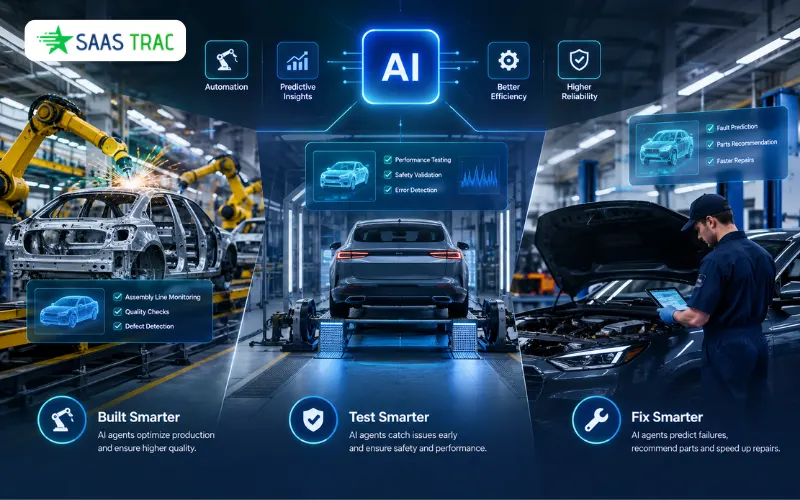
Where Do AI Agents Help During Vehicle Development?
Development is where the clock matters most. Engineers send prototype vehicles out to collect test data, then spend days sorting through logs to work out why something failed. But AI vehicle diagnostic software minimizes engineers’ time to review raw signals, spots patterns, and rules out errant issues – all to reduce time to market. In one podcast episode, an engineer from Nissan Technical Centre Europe described moving from manual, on-site validation to a remote workflow that cut root-cause investigations from two weeks to two days.
Better answers also depend on better data. Many teams now use automotive vehicle data collection AI software, which allows users to deliver monitor prompts in plain language and builds the collection rules for them. This is one of the most compelling uses of generative AI in the automotive industry: a fleet team can ask for data on engine conditions linked to a crankcase pressure problem on a diesel truck without needing to know raw signal formats.
The savings add up in several ways. Engineers spend less time on dead ends, teams get more out of each prototype, and issues are resolved earlier, which helps a new model reach production sooner. Because early prototypes often have unfinished systems that interact and produce noisy results, an AI that can say “it’s not this” is as valuable as one that says “it’s that.”
There is a people benefit here as well. Test and validation engineers are highly skilled, yet much of their day often goes to wrangling data rather than solving problems. When an AI agent handles the sorting, the humans get to do the part they trained for: forming hypotheses, making design calls, and deciding what to try next. Teams that adopt these tools tend to find that the technology changes how work is divided, not who is responsible for the result.
How Do AI Agents Help After a Vehicle Leaves the Factory?
Once a vehicle is on the road, the challenge shifts from building it to keeping it running. Service teams now face intermittent faults, black screens, and failed over-the-air updates, problems a basic code reader was never designed to explain. Faced with uncertainty, a technician may replace a part that was never faulty, which adds cost and keeps the owner waiting.
AI agents help by combining fault codes with manuals, sensor readings, and repair history, then returning a ranked list of the most likely causes in plain language. The goal is not to replace the technician. It is to give a good technician a better starting point, which improves the odds of fixing the problem on the first visit and trims warranty costs.
There is also a fleet effect. When a fix works on one vehicle, the pattern can inform recommendations for every similar vehicle, so problems can be spotted before a warning light ever appears. For commercial operators, where a truck in the shop is a truck not earning money, that kind of predictive maintenance can be especially valuable.
What Challenges Come With Putting AI Inside Vehicles?
Optimism should come with realism. Vehicles are not cloud servers. As the Arm executive in that podcast points out, in-vehicle software has to respect functional safety and real-time requirements that most cloud applications never face. That means AI features need careful design, thorough testing, and clear boundaries around what they are allowed to do.
Data quality matters too. An AI agent is only as helpful as the signals it can see, and teams that invest in clean, well-organized data usually get better recommendations. Finally, trust has to be earned. Technicians and engineers adopt tools that explain their reasoning and admit uncertainty, not tools that ask for blind faith.
Rollout strategy matters as well. The teams that see the best results usually start with one narrow, well-defined problem, such as diagnosing a recurring fault or monitoring a single subsystem, prove the value there, and then expand. A small win builds the confidence and the data foundation that larger projects need.
What Can Software Teams in Other Industries Learn From This?
You do not need to work in automotive to borrow the playbook. The same ideas apply to any complex product that generates data:
- Start with the question, not the data dump. Collect what answers a specific problem so you are not paying to store information nobody will use.
- Let non-specialists ask in plain language. When a support lead or operations manager can request an analysis directly, expertise stops being a bottleneck.
- Keep a human in the loop. The best systems keep every recommendation visible and editable, so people stay in charge of the final call.
- Let every case teach the next. Shared learning across a fleet, a customer base, or a product line compounds over time.
What Should You Look For When Evaluating AI Agent Tools?
Whether you are shopping for software in automotive or elsewhere, a few questions help separate useful tools from hype:
- Does it work with the data you already have? Standards-based integration matters more than a flashy demo.
- Can you review and adjust what the AI produces? Editable outputs build trust and catch mistakes early.
- How does it handle privacy? Look for clear controls over what data is collected and compliance with rules such as GDPR and CCPA.
- Can the vendor show measurable outcomes? Time to root cause, first-time fix rate, or hours saved give you something concrete to compare.
- Does it fit how your team already works? Tools that slot into existing workflows get adopted; tools that demand a rebuild often stall.
Summing It Up
AI agents are moving well beyond chat windows and creative tools. In vehicles, they are shortening test cycles, making data collection accessible to more people, and helping technicians fix problems faster. The lessons carry over to any team managing complex software: collect data with purpose, keep people in control, and measure results. As these systems mature, expect the line between a software product and an intelligent product to keep fading.