
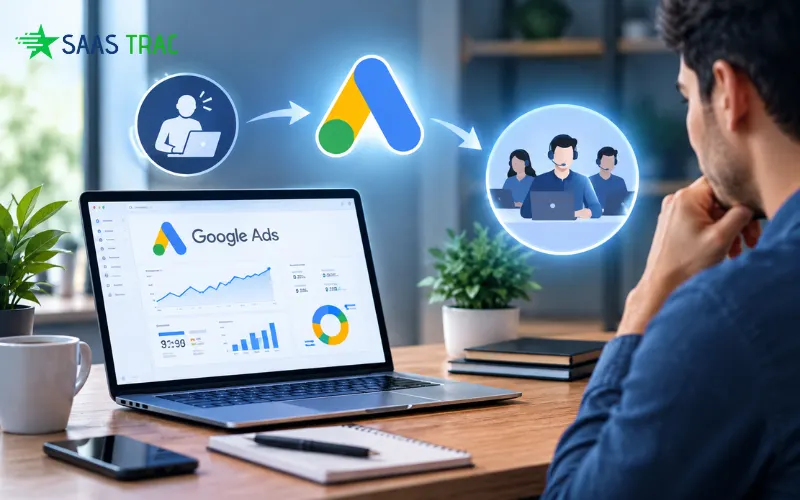
Google Ads can be one of the most measurable ways to generate leads, sales, and enquiries. It also has a habit of becoming more complicated just as a business starts to rely on it.
Campaign structures expand, search terms multiply, conversion tracking becomes harder to interpret, and competitors keep bidding on the same valuable keywords. What began as a straightforward in-house task can turn into a time-consuming specialist function.
Outsourcing Google Ads is not automatically the right answer. Plenty of businesses can manage paid search internally, particularly when campaigns are small, goals are simple, and someone on the team has the time to learn the platform properly. The real question is whether your current approach is producing reliable results—or merely keeping campaigns active.
The Signs Your Google Ads Account Has Outgrown Its Current Setup
The clearest sign is not necessarily poor performance. Sometimes an account generates leads, but nobody knows which campaigns are genuinely profitable, whether those leads convert into customers, or where budget is being wasted.
A healthy Google Ads account needs ongoing attention. Search queries should be reviewed, bids and budgets adjusted, landing pages tested, and conversion data checked for accuracy. If those jobs happen only when someone has a spare afternoon, performance will usually plateau.
There are several common warning signs:
- Spend is increasing while cost per lead or acquisition rises.
- Reporting focuses on clicks and impressions rather than revenue or qualified leads.
- Conversion tracking is incomplete, unreliable, or limited to form submissions.
- Campaigns have not been meaningfully reviewed for months.
- Internal teams lack the time to test ad copy, audiences, or landing pages.
- Decisions are based on platform recommendations without independent analysis.
None of these issues means your team is incapable. More often, it means paid search has become a larger discipline than the organisation originally expected. Google Ads now requires a working understanding of automation, attribution, feed management, audience signals, consent settings, and business economics—not simply keyword selection.
What Outsourcing Should Actually Solve
Outsourcing works best when it fills a defined capability gap. It should not be a way to avoid understanding your own marketing numbers.
Before handing campaigns to an external partner, identify what is missing internally. Is it strategic direction? Technical tracking expertise? Capacity for weekly optimisation? Experience with ecommerce feeds or lead-generation qualification? The answer shapes the kind of support you need.
Better Measurement Before Bigger Budgets
A common mistake is assuming that a weak campaign needs more spend to gather data. Often, the problem is that the data being collected does not reflect business value.
For a service company, a completed contact form may be less meaningful than a qualified call that results in a booked consultation. For an ecommerce brand, revenue is useful, but profit margin, repeat purchase behaviour, and stock availability may be more important still.
This is where experienced external support can make a difference. A provider offering performance-focused PPC management should begin by examining tracking, lead quality, and commercial objectives—not by promising a particular number of clicks. The goal is to create a feedback loop between advertising activity and real outcomes.
That may involve importing offline conversions from a CRM, separating branded from non-branded demand, or assigning different values to high- and low-intent enquiries. These details often determine whether automation improves performance or simply scales inefficient spending.
Access to Specialist Knowledge
Google Ads changes constantly. Match types have evolved, automated bidding has become more prominent, and Performance Max campaigns have altered how advertisers think about channel-level control. Keeping up is possible in-house, but it takes time.
An experienced specialist brings pattern recognition. They may spot an overreliance on branded traffic, identify irrelevant search themes, or recognise when a landing page—not the ad account—is constraining conversion rate. They should also be able to explain their reasoning in plain language.
That last point matters. Outsourcing does not mean surrendering visibility. You should still understand what is being changed, why it matters, and how success will be judged.
When Keeping Google Ads In-House Makes Sense
There are cases where outsourcing is unnecessary, at least for now. A small local business with a tightly focused campaign and modest budget may benefit more from improving its website and conversion tracking first. Similarly, a company with a skilled in-house marketer, clear data infrastructure, and time for regular optimisation may have little need for day-to-day external management.
In-house management also has one major advantage: proximity to the customer. Internal teams often understand seasonality, product nuances, sales objections, and operational constraints better than anyone outside the business.
The strongest arrangements frequently combine both perspectives. An internal team supplies commercial context and fast feedback from sales, while an external specialist provides technical depth, independent analysis, and dedicated optimisation time.
How to Assess Whether Outsourcing Is Worth It
Rather than comparing an agency fee solely with your current ad spend, compare it with the cost of missed opportunities. How much revenue is lost when leads are poorly tracked? How much time does your team spend troubleshooting campaigns instead of working on higher-value activity? How much budget goes to searches that will never become customers?
Start with a practical audit of the last three to six months. Review conversion volume, lead quality, impression share, search terms, and performance by device, location, and campaign type. Then ask whether someone has clear ownership of the next steps.
If the answer is no, external support may be justified. But set realistic expectations. A new manager cannot repair weak landing pages, unclear offers, or limited demand overnight. Good PPC management is iterative: test, learn, refine, and scale what works.
Choosing the Right Level of Support
Outsourcing does not have to mean a full handover. Some businesses need a one-off account audit, tracking implementation, or strategic review. Others need ongoing campaign management because their spend, product range, or competitive environment changes too quickly for occasional intervention.
Whatever model you choose, look for transparency. Reporting should connect ad performance to business outcomes. Meetings should include discussion of lead quality, not just dashboard metrics. And recommendations should be specific enough to challenge constructively.
The best time to outsource Google Ads is not when campaigns have completely failed. It is when the gap between what the account could achieve and what your team can realistically manage has become too wide to ignore.