
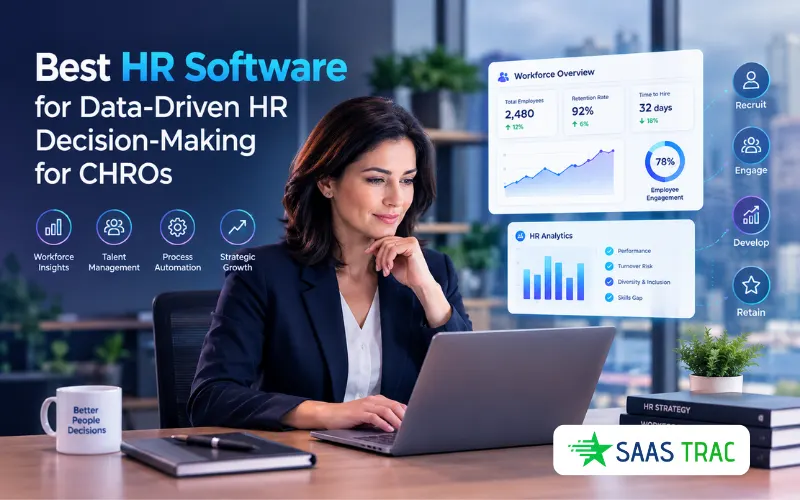
A CHRO today is expected to answer questions that used to sit comfortably in a quarterly slide deck: which team is about to lose a key person, where hiring is falling behind, whether pay is genuinely equitable across departments. Waiting for a monthly report no longer cuts it. The best HR software is increasingly judged on how well it turns raw workforce numbers into something a CHRO can act on this week, not next quarter.
The HR function itself has quietly become a data pipeline inside most large organisations. Every leave request, every performance review, every attendance record feeds into a system somewhere, and the value of that system now depends entirely on what it does with all that information afterwards. Here is how seven platforms handle that job differently.
PeopleStrong
PeopleStrong’s analytics capability is built around predictive insight rather than static, retrospective reporting. Embedded in a unified cloud HCM platform serving over 650+ large enterprises and millions of employees across India and APAC, its analytics engine delivers real-time visibility across complex, multi-entity organisation structures.
The platform’s predictive attrition risk scoring is among its most consequential features. It flags employees likely to leave before any resignation lands on HR’s desk, giving leaders the lead time to intervene. CHROs and HR executives can monitor workforce composition, span of control, skill gaps, and organisational density through dashboards configured to their own priorities rather than a vendor’s defaults. The analytics draw on the same native data foundation as core HR, leave, attendance, and payroll, so the figures reflect live operational reality, not the delayed, manually compiled snapshots that monthly reporting typically produces.
Workday
Workday’s core proposition is a single source of truth for HR and finance data; headcount, compensation and cost figures in one system rather than two parallel spreadsheets that someone has to reconcile before every board meeting. The practical effect is that leaders stop arguing about whose numbers are right and start making decisions. This matters most where workforce choices carry direct budget consequences: a CHRO can model the financial impact of a hiring or restructuring decision without waiting on a separate finance cycle to catch up.
greytHR
greytHR keeps its reporting close to the ground, focused on the numbers HR teams actually check each day. Attendance patterns, leave trends and payroll cost variances are tracked automatically and surfaced through dashboards that flag anomalies as they appear, no elaborate setup required. It makes no attempt to match the predictive depth of larger enterprise platforms, and that restraint is arguably the point. For HR teams without a dedicated analytics function, greytHR offers a realistic way to start using data in day-to-day decisions, rather than paying for a feature set that would need a data scientist to unlock.
ZingHR
ZingHR’s analytics draw directly from the operational data its mobile-first attendance and workforce tools capture in the field, which makes sense given the industries it serves: retail, manufacturing, and field operations. Productivity and deployment data feed into dashboards that show how workforce decisions affect actual business output. That link between HR metrics and operational performance is a distinctly different angle from platforms that stop at engagement scores, and it gives CHROs overseeing large distributed teams a more direct case for where to invest.
HROne
HROne’s dashboard follows the same inbox-style logic that runs through the rest of its platform. Rather than static charts, it surfaces pending approvals, policy exceptions, and workflow delays as items to act on. This makes it particularly useful for diagnosing where the HR process itself is slowing down, whether that’s approvals stuck with a particular manager or a recurring bottleneck in onboarding, rather than tracking outcomes only after the damage is done.
FactoHR
FactoHR’s reporting strength lies in attendance, shift patterns, and workforce deployment, a focus that reflects the industries it was built for. Overtime trends, shift compliance, and geo-tagged attendance data from multiple locations are consolidated into reports that make labor cost drivers legible at a glance. For organizations where costs are driven by shift-based and field workforces rather than salaried headcount, this produces a sharper picture than most general-purpose HR platforms can offer.
Sage HR
Sage HR keeps its reporting deliberately simple, covering leave trends, performance ratings and basic workforce demographics through a clean dashboard. It does not attempt to be a predictive analytics engine, and for organisations with lighter compliance and reporting needs, that restraint works in its favour. Teams without a dedicated analytics resource can build a reporting habit quickly, rather than getting stuck configuring features they will never touch.
What Actually Separates Useful Analytics from Decoration
A dashboard by itself does not make an HR process data-driven. The real question is whether the numbers on screen reflect what is happening right now in the organization and whether they point towards an actual decision rather than just describing what already happened.
A few things tend to separate platforms that genuinely help from those that just look impressive in a demo. Does the system predict outcomes, such as who is likely to leave or where hiring gaps will appear, or does it only report on the past after the fact? Can a team lead or regional manager slice the data by location, team, or line manager without raising a ticket with IT? And is the analytics layer drawing from live data, or working off exports that are already weeks old by the time anyone opens them?
For a CHRO trying to build a genuinely data-driven function, the platform worth choosing is the one that moves decisions earlier than they would otherwise happen, not the one with the most polished-looking charts. That distinction matters far more than any individual feature on a comparison sheet. It is also, more often than not, what separates the best HR software from a system that simply hands numbers back.