


Mapping platforms promise a lot. They promise visualization, territory management, route planning, and data layering, all wrapped in subscription plans that can look similar at a glance. But once you start comparing what you actually get at each price point, the differences between platforms become hard to ignore.
eSpatial and Maptive both operate in the cloud-based location intelligence space, and they both serve teams that need to turn address-level data into something they can act on. Where they split is in how they package their features and what it costs to access everything.
eSpatial, a company headquartered in Dublin, Ireland, with a US office in Virginia, has been building mapping tools since 1997 and works with over 5,000 organizations globally.
Maptive, based in San Francisco with a team of more than 30 people across the US and Canada, serves organizations including Amazon, General Electric, the US Department of Energy, and Coca-Cola.
This article compares the two platforms across pricing, features, performance, integrations, and support to help you figure out which one gives you more for what you spend.
How the Pricing Models Stack Up?

The way each platform charges for access tells you a lot about how they think about their product.
eSpatial starts at $1,495 per year and offers 4 pricing editions that range from $0 to $4,995. The company uses a modular approach, meaning the base plan covers core mapping and data visualization, and you add on the eTerritory or eRouting modules separately, depending on what your team needs. A free trial is available. This works well if your requirements are narrow, but the total cost increases as you layer in territory management and routing.
Maptive prices things differently. A 45-day pass costs $250 with full feature access. The annual plan for a single user is $1,250 per year, which includes up to 400,000 geocodes monthly. A team annual plan runs $2,500 per year, supports up to 1,000,000 geocodes monthly, and adds collaboration features. New users can evaluate the platform through a 10-day free trial that includes all professional features and does not require a credit card. The key distinction here is that every plan includes every tool, every census data layer, and every integration. There are no tier restrictions and no add-on fees.
For budget planning, this matters. With eSpatial, you need to calculate the cost of each module you might need down the line. With Maptive, the price you see is the price you pay for the full platform, and the only variable between plans is the number of users and geocoding limits.
Feature Organization and Access
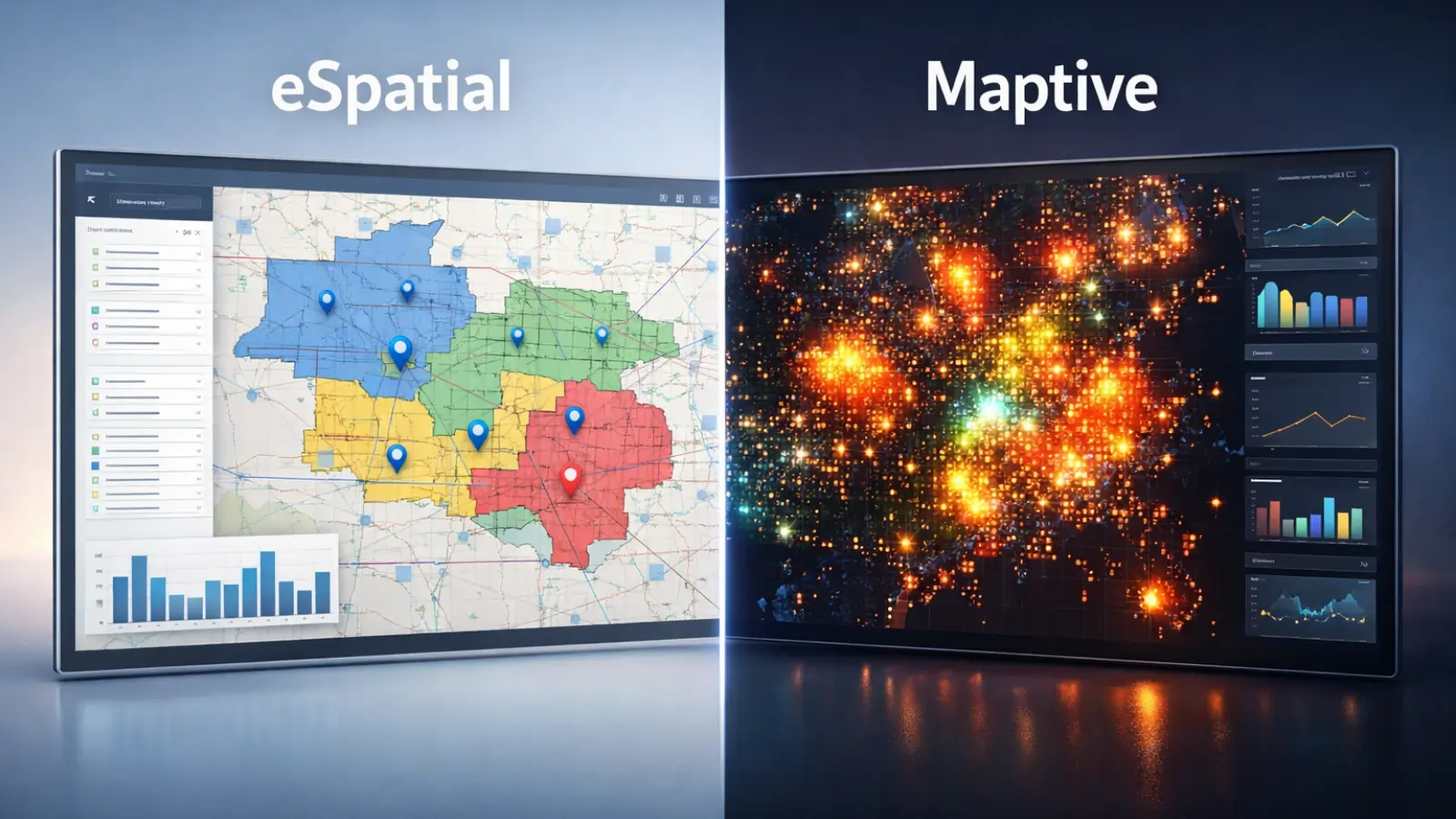
eSpatial’s Three-Module Structure
eSpatial organizes its tools into 3 solutions. eMapping gives you a suite of data visualization tools for creating regional and hotspot heatmaps, running proximity analyses using radius or drive time, and styling your data to show ranges, categories, or individual locations. eRouting is a route optimization tool that helps you select customers to visit and build an optimized schedule around your availability. eTerritory handles territory design, realignment, and optimization using workloads or weighted balances. Each module is purpose-built, and the result is tight functionality aimed at sales operations.
Maptive’s All-In-One Approach
Maptive bundles everything together across all plans. Users upload location data from spreadsheets or CRMs and apply features to create custom maps, including heat maps, color-coded pin maps, sales territory maps, optimized routes and directions, and demographic maps. The platform includes over 60 tools and access to more than 100,000 data layers. There is no need to purchase separate modules to unlock specific capabilities.
Territory Management in Practice
Territory balancing is a core selling point for both platforms, and the way each handles it is worth examining closely.
eSpatial lets users balance territories on any metric, including revenue, potential revenue, workload, or number of accounts. The tool can also minimize drive time within each territory. You can automatically optimize territories in seconds, balance or break down any numeric field per territory, and create an index from multiple variables for balancing. Users can view maps side by side with corresponding tables that show before-and-after comparisons.
Maptive introduced automated territory optimization through Maptive iQ, which launched in March 2025. The algorithm factors in drive times, customer density, workload, and 7 other constraints to build fair territories. According to the company, businesses using these features report a 20% increase in sales productivity when territories balance travel time against account density. The process that previously took about 2 weeks can now be completed in an afternoon.
Route Planning and Field Operations

eSpatial’s eRouting module focuses on field sales optimization and comes with native mobile applications for Android and iOS devices. These apps let staff manage, discover, and optimize routes based on new opportunities while in the field.
Maptive handles route planning with optimization that accommodates up to 73 locations per trip, powered by Google’s routing engine. Field teams using the platform report 18% fuel savings and 22% more daily service calls. Drive-time polygons can be created for trips up to 8 hours. The March 2025 release of Maptive iQ also introduced enhanced drive-time calculations and WebGL rendering, which improved the speed and accuracy of route-related features.
Processing Power and Data Capacity
Performance differences between the two platforms become apparent when working with large datasets.
Maptive is built on Google Maps Platform infrastructure with WebGL rendering, and the platform processes datasets exceeding 200,000 markers while delivering sub-second response times. It handles more than 50,000 rows in under 30 seconds without browser lockups and plots entire address databases at a rate of 10 per second. WebGL map rendering, introduced in May 2025, pushed these numbers even further.
eSpatial does not publish comparable performance benchmarks publicly. Reviewers do note its ability to handle large datasets and create detailed maps, though some users mention that eSpatial periodically freezes during mapping sessions. These freezes reportedly do not last long, but they are worth noting for teams working with high-volume data on tight deadlines.
Data Layers and Demographics
The volume of available data layers is where you start to see a real gap.
Maptive integrates over 100,000 data layers through a partnership with an industry-leading data provider that has more than 30 years of experience serving Fortune 500 companies. The platform also pulls population data directly from the US Census, giving users access to population density, age, median household income, race, and education levels without uploading anything extra.
eSpatial supplies organizations with free datasets from the US, Canada, UK, and other regions. Users can overlay census information onto their data for deeper analysis. However, the total scope of eSpatial’s available data layers is not as broadly documented as Maptive’s 100,000+ figure.
CRM Connectivity

For teams that rely on CRM systems, integration support can determine how smoothly a mapping platform fits into existing workflows.
eSpatial integrates with Salesforce Sales Cloud and does not have an API available. This makes its integration story tightly focused on Salesforce. Users have praised the ability for sales and marketing teams to view and collaborate on the same project directly within Salesforce in real time.
Maptive connects with Salesforce, and the first users are already syncing over 50,000 leads weekly for territory assignment. The platform also integrates with Zoho, Keap, and Pipedrive. HubSpot and additional Zoho features are being tested for release later in 2025. API enhancements enable bidirectional sync with Salesforce and HubSpot, which means data flows both ways without manual exports. If your organization uses a CRM other than Salesforce, Maptive gives you more options.
Security and Uptime
Maptive includes 256-bit SSL encryption for data in transit and at rest, 2-factor authentication, single sign-on integration, and audit logging. The platform has passed the Salesforce AppExchange security review and maintains 99.9% uptime with zero major outages documented in 2025. The underlying infrastructure runs on Google Cloud, and the Google Maps integration provides 99.99% uptime with location data covering over 210 countries.
eSpatial also appears on the Salesforce AppExchange and lets businesses manage user access and admin controls. However, its publicly documented security certifications are less prominently detailed than Maptive’s listed protocols. eSpatial does not publish comparable uptime figures.
Customer Support Quality
Both platforms receive positive feedback on support, which is worth recognizing.
eSpatial users note that the support staff have been very helpful and have gone above and beyond normal customer service. Real mapping experts guide users through onboarding with no professional service costs. Reviewers describe the team as genuinely invested in seeing projects succeed.
Maptive’s support team scores 9.7 out of 10 on G2 for quality of support. Response times are under 15 minutes, and the team of more than 30 people is based in the US and Canada. Support specialists are trained mapping experts who understand spatial analysis and territory management. This level of service applies across all pricing tiers, meaning small businesses receive the same support as enterprise clients.
Third-Party Review Scores

Independent review platforms give both tools favorable ratings. eSpatial’s reviews are based on 53 verified user reviews on GetApp. On Capterra, Maptive holds an overall rating of 4.6 based on 7 user reviews. On G2, Maptive has 35 reviews with an average score above 4.5 out of 5, and ease of setup is rated at 9.3. eSpatial has a larger volume of reviews on certain platforms, which reflects its longer time in the market. Maptive’s reviews, while fewer in number, are consistently strong in satisfaction scores.
Getting Started and Learning Curve
Maptive allows most teams to start creating maps within 30 minutes. The software runs in a browser without requiring installation, and all features are available immediately after logging in. Users can build functional dashboards on their first day.
eSpatial is described by users as intuitive, with maps that are easy to follow for both the creator and the audience. Unlike heavy-duty GIS platforms, eSpatial prioritizes accessibility. This focus on simplicity for business-critical tasks is noted favorably in user reviews.
Visualization Tools and Map Types
Both platforms offer a solid range of map types, though the breadth of customization differs.
eSpatial enables the creation of pin maps, territory maps, radius maps, bubble maps, and route maps. Users can also create regional and hotspot heatmaps and choose optimal locations through proximity maps.
Maptive builds on a Google Maps foundation and offers heat maps, sales density maps, territory maps, store locators, and more. Users can customize markers with their own colors and logos, layer heat maps, choropleths, bubble maps, and pie charts on the same view, then export at print-ready resolution or embed interactive maps directly on a website.
Sharing and Export Options
eSpatial allows users to securely share maps online and export them in various formats, including high-resolution print for presentations.
Maptive offers multiple sharing methods. Private sharing keeps maps within an organization with controlled view or edit permissions. Public sharing creates links for customers or partners. Website embedding places interactive maps directly on company pages.
Which Platform Gives You More for the Money?
Maptive is the better fit for organizations that want every feature available from day one without worrying about tier upgrades or module add-ons. Its pricing model includes route optimization and all premium features without additional charges, which gives you budget predictability throughout the subscription period. Broader CRM integrations, a larger data layer library with 100,000+ datasets, higher documented marker capacity at 200,000+, and its foundation on Google Maps Platform give it an edge for teams that need versatility and scale. When you measure total features against total cost, Maptive covers the widest ground and delivers strong capability per dollar spent.
On the other hand, eSpatial takes a more modular and structured approach, which may appeal to organizations that prefer a tailored setup over an all-in-one bundle. Instead of offering every feature upfront, eSpatial allows businesses to configure their environment based on specific needs, particularly in areas like territory management and sales mapping. This can be advantageous for teams that want tighter control over feature usage or are working with more defined, use-case-driven workflows.